
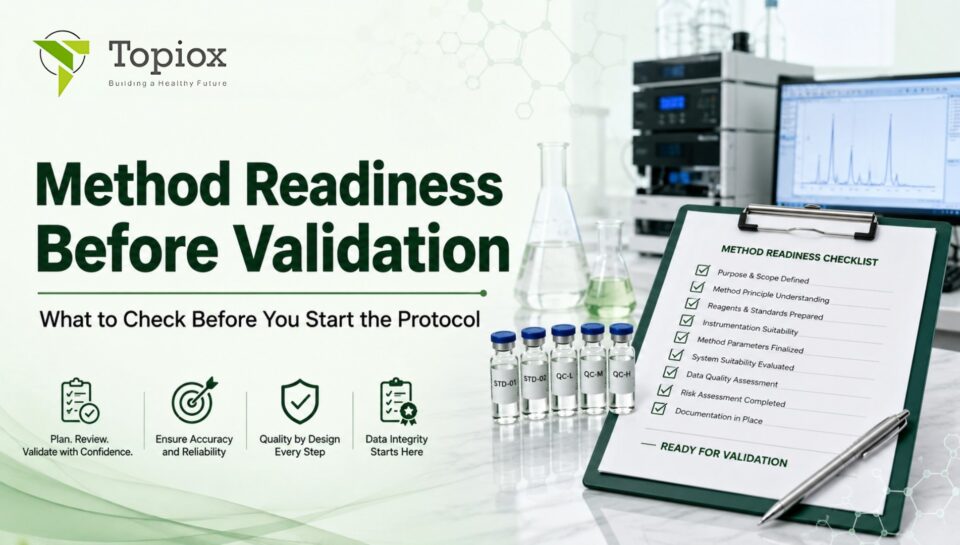
Direct Answer: What Should Be Checked Before Method Validation Begins?
Before method validation begins, the analytical method should demonstrate consistent performance, adequate specificity, suitable sensitivity, acceptable precision, linear response, appropriate system suitability, sample and standard stability, robustness, and reproducibility under the intended operating conditions. Confirming these characteristics before validation helps reduce the risk of validation failure and supports reliable analytical performance.Quick Takeaway
Method validation should confirm the performance of an optimized analytical procedure not compensate for unresolved development issues. Assessing method readiness before validation improves study efficiency, strengthens data quality, and reduces the likelihood of repeat validation activities.What Is Method Readiness?
Method readiness refers to the stage at which an analytical procedure has been sufficiently developed, optimized, and evaluated to support formal validation. A validation-ready method should demonstrate:- Consistent chromatographic performance
- Stable analytical response
- Reproducible results
- Appropriate selectivity
- Reliable quantification
- Practical suitability for routine laboratory use
Why Method Readiness Matters
Analytical method validation requires significant laboratory time, analytical resources, and regulatory documentation. Beginning validation before a method is adequately prepared may result in:- Validation failure
- Excessive variability
- System suitability failures
- Investigation reports
- Additional optimization work
- Project delays
- Increased development costs
Critical Checks Before Validation Begins
Method Performance Consistency
The method should produce reproducible results across multiple analytical runs using the intended operating conditions. Consistent retention times, peak shape, detector response, and system suitability provide confidence that the method performs reliably.Specificity
The analytical procedure should distinguish the analyte from impurities, degradation products, excipients, matrix components, and potential interferences. Specificity should be demonstrated during method development before formal validation.Sensitivity
The method should possess sufficient sensitivity for its intended analytical application. Detection capability should align with specification limits, impurity requirements, and intended reporting levels.Chromatographic Performance
Chromatographic parameters should be stable and reproducible. Typical observations include:- Peak symmetry
- Resolution
- Retention time consistency
- Baseline stability
- Signal-to-noise performance
System Suitability
System suitability criteria should be well established and consistently achieved. Typical parameters may include:- Resolution
- Theoretical plates
- Tailing factor
- Repeatability
- Detector response
Standard and Sample Stability
Analytical solutions should remain stable throughout the anticipated analysis period. Evaluating stability before validation helps prevent unexpected variability caused by degradation during sample analysis.Robustness Assessment
Although robustness is formally evaluated during validation, preliminary robustness studies performed during method development help identify analytical conditions that may significantly influence method performance. Examples include minor variations in:- Mobile phase composition
- Flow rate
- Column temperature
- Detection wavelength
- Buffer pH
Method Ruggedness
The analytical procedure should demonstrate consistent performance under normal laboratory conditions. This may include evaluation of:- Different analysts
- Instruments
- Columns
- Reagent lots
- Laboratory environments
Method Readiness vs Method Validation
Although closely related, method readiness and method validation serve different purposes. Method readiness focuses on confirming that the analytical procedure is sufficiently optimized and capable of consistent performance before validation begins. Method validation formally demonstrates that the validated method meets predefined performance characteristics for its intended analytical application. Method readiness establishes confidence in the analytical procedure, while validation generates documented evidence supporting regulatory acceptance.Common Reasons Validation Fails
Validation difficulties often originate during method development rather than during validation itself. Common causes include:Incomplete Method Optimization
Analytical conditions have not been fully optimized.Poor Peak Resolution
Insufficient separation may compromise specificity.Variable System Suitability
Unstable chromatographic performance may affect reproducibility.Inadequate Sample Stability
Analyte degradation may influence analytical accuracy.Insufficient Robustness
Minor operating changes significantly affect method performance.Limited Method Understanding
Critical analytical parameters have not been adequately characterized. Recognizing these issues before validation improves the likelihood of successful validation outcomes.Topiox Framework for Method Readiness Assessment
At Topiox Research Centre, method readiness can be evaluated through four interconnected scientific considerations.1. Analytical Performance
Confirm consistent chromatographic behaviour, system suitability, and reproducibility.2. Scientific Understanding
Evaluate critical method parameters, analyte behaviour, and potential sources of analytical variability.3. Operational Readiness
Assess sample preparation, solution stability, instrument performance, and routine laboratory applicability.4. Validation Preparedness
Confirm that the analytical procedure is sufficiently mature to support formal validation according to predefined acceptance criteria. Evaluating these four areas together helps establish confidence that the analytical method is ready for validation.Practical Example: Why Readiness Matters
Consider an HPLC method developed for assay determination. Initial optimization produces acceptable chromatographic separation, and the validation protocol is prepared. However, pre-validation assessment identifies that the analyte solution degrades after several hours at room temperature, leading to reduced peak area and increased variability. Addressing this issue before validation by optimizing sample preparation and defining solution stability limits prevents unnecessary validation failures and strengthens the reliability of the final validated method. This example illustrates how pre-validation method readiness can reduce development risk and improve analytical confidence.Regulatory Perspective
Global regulatory expectations emphasize that analytical methods should be scientifically developed before validation is initiated. A risk-based development approach includes:- Method optimization
- Evaluation of critical method parameters
- Preliminary robustness assessment
- System suitability establishment
- Analytical performance verification
- Documentation supporting validation readiness
How Topiox Research Centre Supports Analytical Method Development
At Topiox Research Centre, analytical method development is performed with the objective of establishing methods that are suitable for successful validation and routine laboratory application. Our capabilities may include:- Analytical method development
- Method optimization
- Pre-validation method assessment
- HPLC and UHPLC method development
- LC-MS/MS method development
- Stability-indicating method development
- Analytical method validation
- Regulatory-focused documentation
Faq's
Method readiness is the evaluation of whether an analytical method has been sufficiently optimized and characterized before formal validation begins.
It helps identify unresolved analytical issues before validation, reducing the risk of failed studies, repeat work, and project delays.
Yes. Many validation failures result from unresolved issues such as inadequate specificity, poor robustness, unstable samples, or inconsistent chromatographic performance.
Method performance, specificity, sensitivity, robustness, system suitability, sample stability, chromatographic behaviour, and reproducibility should all be assessed before validation.
Preliminary robustness studies are commonly performed during method development to identify critical variables before formal validation.
Pre-validation assessment helps ensure that validation is performed on a scientifically optimized method, improving data reliability and supporting regulatory expectations.