How Can Excipients Cause Nitrosamine Formation?
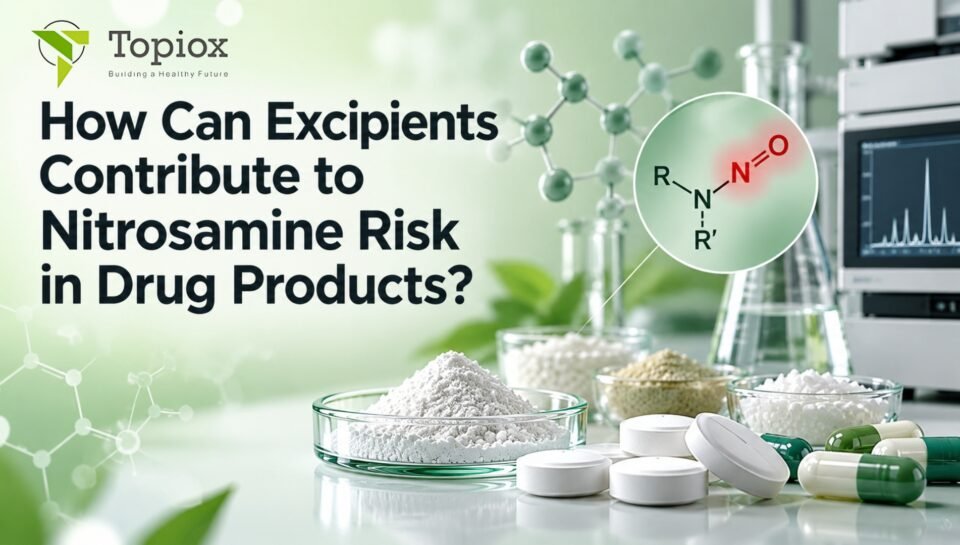
Excipients do not necessarily contain nitrosamines themselves. More commonly, they may contribute precursors or conditions that facilitate nitrosamine formation. A simplified mechanism is: Nitrite in excipient ↓ Nitrosating species under suitable conditions ↓ Nitrosatable amine in API, impurity, degradant, or other component ↓ N-nitrosation reaction ↓ Nitrosamine / NDSRI formation Therefore, three broad elements generally need to align:- A nitrosatable substrate
- A source of nitrosating species
- Conditions favorable for the reaction
Why Nitrite in Excipients Matters
Trace nitrite is one of the most important excipient-related considerations in current nitrosamine risk assessment. Nitrite can be present at low levels in pharmaceutical excipients as a consequence of:- raw-material origin;
- manufacturing processes;
- processing water;
- environmental exposure;
- storage;
- or other material-specific factors.
- grade;
- supplier;
- lot;
- manufacturing location;
- raw-material source;
- storage;
- and environmental history.
Excipients Are Not Equally Important
An excipient containing measurable nitrite does not automatically represent the greatest nitrosamine risk. The total contribution depends on both: Nitrite concentration in the excipient and Amount of that excipient in the formulation Consider two hypothetical excipients.Excipient A
Contains relatively high nitrite but is used at only 0.2% of the formulation.Excipient B
Contains less nitrite per gram but represents 40% of the tablet. Excipient B could potentially contribute more total nitrite to the dosage form. Therefore: Excipient nitrite risk ≠ nitrite concentration alone A more useful assessment considers: Nitrite level × Excipient amount × Product dose × Nitrosation potential This is particularly relevant for high-load excipients such as fillers and diluents.Which Excipients Can Contribute Nitrite?
Nitrite has been detected at varying levels across many pharmaceutical excipient categories. Potentially relevant materials can include, depending on grade and source:- microcrystalline cellulose;
- lactose;
- starches;
- povidone;
- crospovidone;
- croscarmellose sodium;
- sodium starch glycolate;
- magnesium stearate;
- inorganic excipients;
- and other commonly used pharmaceutical materials.
- measured nitrite;
- formulation loading;
- API susceptibility;
- manufacturing conditions;
- storage conditions;
- and total product exposure.
Excipient Nitrite Levels Can Vary Between Suppliers
Supplier variability is particularly important. Two excipients that meet the same pharmacopoeial identity and conventional quality specifications can potentially contain different trace levels of nitrite. This means conventional excipient specifications may not always provide enough information for nitrosamine risk assessment. Berardi and colleagues modeled the effect of changing excipient suppliers and found that changing the supplier of a single excipient could reduce predicted nitrosamine formation substantially, while optimizing several critical excipients produced even larger reductions in the modeled formulations. This creates an important development principle: Supplier selection can become part of the nitrosamine control strategy.Excipient Nitrite May Not Be a Completely Static Attribute
One of the more important recent scientific findings is that nitrite levels in excipients may change after manufacture. A 2026 investigation exposed a broad range of common excipients to nitrogen oxides and observed nitrite accumulation in many materials. The extent depended partly on physicochemical properties such as:- pH;
- specific surface area;
- and excipient chemistry.
API Structure Determines Whether Nitrite Becomes a Nitrosamine Risk
Nitrite alone does not automatically produce a nitrosamine. A nitrosatable amine or related precursor must also be available. This can come from:- the API;
- an API degradant;
- an API impurity;
- a process impurity;
- another formulation component;
- or another relevant source.
Formulation pH Can Influence Nitrosamine Formation
The presence of nitrite and an amine does not guarantee rapid nitrosamine formation. Reaction conditions matter. One particularly important factor is pH. Nitrite chemistry is strongly affected by the local acid-base environment. Under appropriate acidic conditions, nitrite can generate nitrosating species capable of reacting with susceptible amines. This means formulation pH—or even local microenvironmental pH around particles—may influence nitrosamine formation. Importantly, bulk product pH may not always fully represent the microenvironment in a heterogeneous solid dosage form. The scientific question should therefore be: Do the formulation conditions permit meaningful nitrosation over manufacturing and shelf life? rather than: Does the product contain nitrite? Recent research also illustrates this complexity. Carbonate excipients were observed to accumulate relatively high absolute nitrite levels after NOx exposure, but their basic pH could simultaneously create a less favorable environment for nitrosamine formation. Therefore: Higher nitrite does not always translate directly into proportionally higher nitrosamine formation.Moisture Can Influence the Reaction Environment
Water can influence molecular mobility and chemical reaction pathways within a drug product. In solid dosage forms, moisture may affect:- dissolution of trace nitrite;
- mobility of reactive species;
- local pH;
- API–excipient interactions;
- degradation;
- and nitrosation kinetics.
- elevated humidity;
- elevated temperature;
- or other stability conditions.
Manufacturing Process Can Change Excipient-Related Risk
Two formulations containing identical ingredients may not necessarily produce identical nitrosamine profiles. Manufacturing conditions can change the extent to which precursors interact. Relevant variables may include:- wet granulation;
- dry granulation;
- direct compression;
- fluid-bed processing;
- coating;
- drying temperature;
- drying time;
- hold times;
- water addition;
- mixing;
- and environmental exposure.
Why Shelf Life Matters
Nitrosamine formation can continue after manufacturing. During storage, the API and excipients remain in prolonged contact. Over months or years:- nitrite can interact with susceptible amines;
- APIs can degrade;
- new amine-containing degradants can form;
- moisture can change;
- microenvironments can evolve;
- and reaction products can accumulate.
A Practical Excipient Nitrosamine Risk Framework
A useful assessment can follow this sequence:- Identify nitrosatable API structures and relevant degradants ↓ 2. Identify nitrite-containing excipients ↓ 3. Determine excipient loading in the formulation ↓ 4. Evaluate supplier and lot variability ↓ 5. Estimate total nitrite contribution per dosage unit ↓ 6. Assess formulation pH and microenvironment ↓ 7. Evaluate manufacturing conditions ↓ 8. Consider moisture and storage conditions ↓ 9. Identify plausible NDSRIs or other nitrosamines ↓ 10. Conduct confirmatory testing where scientifically warranted ↓ 11. Establish mitigation and lifecycle controls
How Should Excipient Nitrite Contribution Be Evaluated?
A practical starting concept is: Nitrite contribution per excipient = Nitrite concentration × Amount of excipient in the drug product Total formulation nitrite contribution can then be estimated across relevant excipients. But that value alone does not predict the final nitrosamine concentration. Additional factors include:- nitrosatable amine availability;
- reaction stoichiometry;
- percentage conversion;
- pH;
- moisture;
- temperature;
- manufacturing process;
- storage duration;
- and molecular characteristics of the API.
Can Changing Excipient Suppliers Reduce Nitrosamine Risk?
Potentially, yes. If an excipient makes a major contribution to total formulation nitrite, selecting a material with consistently lower nitrite may reduce precursor availability. In theoretical case studies, changing the supplier of one critical excipient reduced predicted nitrosamine formation by up to approximately 59%, while optimizing three important excipients produced reductions of up to approximately 89%. These values came from modeled scenarios and should not be interpreted as universal reductions achievable in every formulation. However, they demonstrate the potential value of excipient selection as a mitigation tool. A supplier change should also consider:- pharmaceutical functionality;
- material variability;
- dissolution;
- manufacturability;
- stability;
- bioavailability;
- regulatory impact;
- and other critical quality attributes.
Can Nitrite Scavengers Reduce Nitrosamine Formation?
Another potential mitigation approach is the use of nitrite scavengers. Compounds investigated include:- ascorbic acid;
- sodium ascorbate;
- α-tocopherol;
- amino acids;
- cysteine;
- propyl gallate;
- and other antioxidants or reactive compounds.
- formulation;
- API;
- reaction mechanism;
- scavenger concentration;
- physical state;
- pH;
- and storage conditions.
Excipient Selection vs Nitrite Scavengers
These strategies address the problem differently.Lower-Nitrite Excipient Selection
Reduces the amount of precursor entering the formulation.Nitrite Scavenger Strategy
Attempts to consume or intercept nitrite before it reacts with the nitrosatable substrate. Where feasible, reducing precursor input can be a particularly direct risk-reduction strategy. However, the most appropriate solution depends on the formulation. A useful development hierarchy can be: Understand the mechanism ↓ Reduce precursor sources where practical ↓ Optimize formulation/process conditions ↓ Evaluate additional mitigation strategies where needed ↓ Confirm effectiveness analytically ↓ Monitor through shelf lifeAnalytical Testing for Excipient-Related Nitrosamine Risk
Analytical testing may occur at several levels.Nitrite Testing of Excipients
This helps identify materials or suppliers contributing significant precursor levels.Amine/Precursor Testing
Relevant amine impurities or degradants may also need investigation.Nitrosamine Confirmatory Testing
Where a plausible risk is identified, sensitive analysis may be required for the specific nitrosamine or NDSRI. Common analytical platforms include:- LC-MS/MS;
- LC-HRMS;
- GC-MS;
- and GC-MS/MS,
Avoiding Nitrosamine Formation During Sample Preparation
A particularly important analytical issue is artifactual nitrosamine formation. If a sample contains both nitrite and a nitrosatable amine, the analytical preparation itself can potentially create conditions that promote nitrosation. This can produce an apparent nitrosamine result that does not accurately represent the original drug product. Research has even demonstrated trace nitrosamine formation inside an LC-MS analytical system when an amine and nitrite were combined under particular conditions. For excipient-related investigations, sample preparation should therefore be evaluated carefully for:- pH;
- extraction solvent;
- extraction time;
- temperature;
- nitrite availability;
- and sample stability.
Regulatory Context for Excipient-Related Nitrosamine Risk
Current regulatory frameworks recognize that nitrosamine formation can occur in the finished drug product, including through interactions between nitrite-containing excipients and nitrosatable APIs or related compounds. For pharmaceutical development teams, the regulatory strategy should integrate: Risk assessment ↓ Identification of plausible formation pathways ↓ Confirmatory testing where risk is identified ↓ Comparison with the applicable acceptable intake ↓ Root-cause investigation ↓ Mitigation and control Acceptable intake limits are nitrosamine-specific and may be established using compound-specific data, read-across, structural approaches such as the Carcinogenic Potency Categorisation Approach (CPCA), or other regulator-supported evidence. Because acceptable intake information and nitrosamine science continue to evolve, current regulatory resources should be checked for the specific impurity rather than relying on historical limits.Common Mistakes in Excipient Nitrosamine Risk Assessment
Assuming All Lots Have the Same Nitrite Level
Excipient nitrite can vary by supplier, lot, material history, and potentially environmental exposure.Looking Only at Nitrite Concentration
Formulation loading also matters.Assuming Nitrite Automatically Means Nitrosamine Formation
A susceptible amine and appropriate reaction conditions are also required.Ignoring pH
Nitrosation chemistry can be strongly dependent on the local chemical environment.Ignoring Manufacturing Conditions
Wet processing, temperature, air exposure, and hold times may alter precursor interaction.Ignoring Shelf Life
Nitrosamine formation can continue during storage.Assuming Supplier Certificates Answer Every Question
Conventional excipient specifications may not fully characterize trace nitrite variability relevant to a particular nitrosamine risk assessment.Changing an Excipient Without Considering Product Performance
Excipient selection affects much more than nitrite.Treating Scavengers as a Universal Solution
Mitigation effectiveness is formulation- and mechanism-specific.Testing Without Understanding the Formation Pathway
Sensitive analysis is most valuable when it addresses a clearly defined scientific risk.Best Practices for Managing Excipient-Related Nitrosamine Risk
Identify Nitrosatable Structures Early
Review the API, impurities, and degradants during development.Build an Excipient Nitrite Map
Understand which excipients contribute the greatest theoretical nitrite load.Consider Both Concentration and Formulation Loading
High-use excipients can matter even at relatively modest nitrite concentrations.Characterize Supplier Variability
Where risk warrants it, evaluate multiple suppliers or lots.Understand Formulation Conditions
Consider pH, moisture, physical state, and component proximity.Evaluate Manufacturing Risk
Assess whether processing increases mobility or creates conditions favorable to nitrosation.Include Stability in the Assessment
Determine whether nitrosamines increase during shelf life.Reduce Precursors Where Practical
Lower-nitrite excipients may provide a direct mitigation route.Evaluate Scavengers Scientifically
Confirm compatibility, effectiveness, and stability rather than assuming benefit.Verify Mitigation Analytically
Demonstrate that the proposed strategy actually reduces the relevant nitrosamine or NDSRI.Maintain Lifecycle Controls
Supplier, process, formulation, or storage changes may justify reassessment.Excipient Risk Assessment at topiox research
Excipient-related nitrosamine risk sits at the intersection of:- formulation development;
- excipient characterization;
- nitrite analysis;
- API and degradant chemistry;
- NDSRI assessment;
- stability;
- LC-MS/MS and GC-MS analysis;
- root-cause investigation;
- and regulatory strategy.
- which excipients contribute nitrite;
- whether the API is susceptible to nitrosation;
- how formulation and process conditions affect risk;
- whether NDSRIs could form during shelf life;
- when confirmatory testing is warranted;
- and which mitigation strategies are scientifically appropriate.
Conclusion
Excipients can play an important role in pharmaceutical nitrosamine risk, particularly when they introduce trace nitrite into formulations containing nitrosatable APIs or related compounds. But nitrite concentration alone does not determine risk. A meaningful assessment should consider:- API and degradant structure
- Nitrite concentration in excipients
- Excipient loading
- Supplier and lot variability
- Formulation pH and microenvironment
- Moisture
- Manufacturing conditions
- Environmental exposure
- Shelf-life formation
- Potential NDSRIs
- Applicable acceptable intake
- Mitigation and lifecycle control
FAQ'S
Excipients can introduce trace nitrite or influence formulation conditions. If nitrite encounters a susceptible amine under conditions favorable to nitrosation, nitrosamines or NDSRIs may form.
The main excipient-related concern is often not pre-existing nitrosamine but nitrite or other precursors that can participate in nitrosamine formation within the drug product.
Nitrite has been reported at varying levels across multiple pharmaceutical excipient categories. The actual level can depend on excipient type, grade, supplier, lot, and material history, so risk should be assessed using product-specific data rather than a universal list.
Yes. Published data demonstrate supplier-related variability, and modeling indicates that selecting lower-nitrite sources can materially reduce theoretical nitrosamine formation.
Recent research indicates that some excipients can accumulate nitrite following exposure to environmental nitrogen oxides, suggesting that nitrite may not always behave as a completely static material attribute.
Potentially. Selecting a lower-nitrite supplier or excipient can reduce precursor input, but any change must also be evaluated for its effects on product quality, performance, stability, and regulatory status.