- donor-to-donor variability;
- skin thickness and preparation;
- barrier integrity;
- dose application;
- receptor-medium composition;
- diffusion-cell conditions;
- sampling schedule;
- formulation properties;
- analytical sensitivity;
- and statistical design.
What Is IVPT Study Design?
IVPT study design is the structured selection of experimental, biological, analytical, and statistical conditions used to measure and compare the rate and extent of drug permeation from topical products through excised skin. A typical IVPT study may involve: Topical formulation ↓ Finite dose application ↓ Excised human skin ↓ Diffusion cell system ↓ Receptor medium ↓ Serial sampling ↓ Bioanalytical quantification ↓ Flux and cumulative permeation profiles ↓ Statistical comparison Unlike IVRT, which primarily evaluates release of the drug from the dosage form using a synthetic membrane system, IVPT uses a biological skin barrier and therefore captures the interaction between the formulation and skin. This makes IVPT particularly valuable for evaluating cutaneous drug delivery.Why IVPT Study Design Matters
IVPT is a sensitive experimental model, but that sensitivity also means poorly controlled study variables can introduce substantial noise. An IVPT study can fail to provide meaningful information if:- skin sections vary excessively;
- donor numbers are insufficient;
- the skin barrier is compromised;
- receptor conditions alter barrier function;
- formulation dosing is inconsistent;
- sampling times do not adequately characterize the permeation profile;
- or the statistical design does not appropriately account for donor and replicate variability.
Factor 1: Clearly Define the Purpose of the IVPT Study
The first question should be: What is this IVPT study intended to demonstrate? The study may be designed to support:- formulation screening;
- excipient evaluation;
- prototype optimization;
- understanding of topical pharmacokinetics;
- comparison of test and reference products;
- evaluation of formulation changes;
- regulatory development;
- or a topical bioequivalence strategy.
- skin donors;
- replicate numbers;
- dosing conditions;
- sampling schedules;
- endpoints;
- or statistical methods.
Factor 2: Select an Appropriate Skin Source
The biological membrane is one of the most important components of an IVPT study. For topical drug development, excised human skin is generally considered highly relevant because it represents the barrier through which the drug must permeate clinically. IVPT research commonly uses human skin mounted in Franz-type or flow-through diffusion cells. Important skin-related variables can include:- donor source;
- anatomical site;
- donor age;
- donor sex;
- skin thickness;
- storage conditions;
- preparation method;
- dermatoming;
- and barrier integrity.
Factor 3: Use Multiple Donors and an Appropriate Replicate Strategy
IVPT studies must account for biological variability. Skin sections from a single donor cannot fully represent the variability expected across a population. A stronger design uses multiple skin donors and replicate sections within each donor. This allows the experiment to distinguish: Product-related differences from Donor-related biological variability. FDA educational materials on characterization-based topical BE approaches have described pilot IVPT designs using skin from multiple donors, with several replicate sections per donor and treatment, to help characterize variability and estimate the sample size needed for pivotal studies. The exact number of donors and replicates should be justified for the specific study. A key principle is: More diffusion cells do not compensate for insufficient donor diversity. A study with many replicates from very few donors may provide excellent technical replication while inadequately representing biological variability.Factor 4: Confirm Skin Barrier Integrity
A permeation study is meaningful only if the skin retains an appropriately competent barrier. Damaged skin can permit artificially high drug permeation and distort product comparisons. Common approaches used to evaluate skin integrity include:- transepidermal water loss (TEWL);
- electrical resistance;
- and permeability-based integrity tests.
Factor 5: Select the Receptor Medium Carefully
The receptor phase must support collection and quantitation of the drug that permeates through the skin. A suitable receptor medium should provide adequate drug solubility while avoiding unnecessary alteration of the skin barrier. This balance can be difficult for poorly water-soluble APIs. Potential receptor-medium components may include:- buffers;
- salts;
- proteins;
- cyclodextrins;
- co-solvents;
- or other scientifically justified additives.
Factor 6: Define Dose Application and Exposure Conditions
Topical products are typically applied to the skin in relatively small amounts under finite-dose conditions. Dose application should be standardized because differences in applied amount or spreading can change permeation. Important considerations include:- dose per unit area;
- application technique;
- spreading area;
- formulation loss during dosing;
- occluded versus unoccluded conditions;
- exposure duration;
- and dose removal procedures where applicable.
Factor 7: Control Diffusion-Cell Conditions
IVPT commonly uses static Franz diffusion cells or flow-through diffusion systems. Key experimental variables include:- diffusion area;
- receptor volume;
- temperature;
- stirring;
- cell assembly;
- skin orientation;
- receptor-medium contact;
- sampling-port configuration;
- and absence of bubbles beneath the skin.
Factor 8: Design the Sampling Schedule Around the Permeation Profile
IVPT is fundamentally a kinetic study. A single endpoint cannot fully describe how rapidly drug permeates through the skin. Serial receptor samples are therefore collected to generate a permeation-versus-time profile. Sampling times should allow characterization of:- onset of permeation;
- increase in flux;
- maximum flux where relevant;
- duration of permeation;
- cumulative amount permeated;
- and potential late-stage changes.
- maximum flux (Jmax);
- and total cumulative amount permeated (AMT).
Factor 9: Use a Fit-for-Purpose Bioanalytical Method
IVPT can generate complex sample types. Depending on study design, analysis may involve:- receptor samples;
- epidermis;
- dermis;
- residual formulation;
- surface wash;
- or other relevant fractions.
- sensitivity;
- selectivity;
- accuracy;
- precision;
- matrix effects;
- sample stability;
- extraction recovery;
- and calibration range.
Factor 10: Plan the Statistical Analysis Before the Study Begins
Statistical planning should be part of IVPT study design, not an afterthought. The study structure may contain multiple levels of variability: Between products Between donors Between skin sections from the same donor Between diffusion cells Analytical variability A statistically appropriate design should reflect this structure. For comparative studies, predefined endpoints and analysis methods should be selected before the pivotal experiment begins. Pilot studies can provide valuable estimates of variability and help determine how many donors and replicates may be required in a later comparative study. FDA specifically notes the value of pilot studies for evaluating permeation profiles, precision, reproducibility, selectivity, dose depletion, and sample-size considerations. Poor statistical planning can make a technically well-executed IVPT study difficult to interpret.The Role of Pilot IVPT Studies
A pilot study is one of the most valuable risk-reduction tools in IVPT development. The pilot can help answer questions such as:- Does the API permeate at quantifiable levels?
- Is the sampling schedule appropriate?
- Is the receptor medium suitable?
- Is the skin preparation method reproducible?
- Is variability manageable?
- Does the method distinguish relevant product differences?
- How many donors may be required in the pivotal study?
- Are the planned analytical endpoints feasible?
Why Donor Variability Matters So Much in IVPT
Donor variability is one of the defining characteristics of IVPT. Differences in:- skin thickness;
- lipid composition;
- age;
- anatomical location;
- barrier characteristics;
- hydration;
- follicular density;
- and storage history
IVPT Study Design and Topical Formulation Properties
IVPT should be interpreted alongside knowledge of the formulation. Skin delivery can be influenced by:- API thermodynamic activity;
- API solubility;
- excipient interactions;
- viscosity;
- rheology;
- evaporation;
- occlusion;
- microstructure;
- emulsion characteristics;
- and drug partitioning between formulation and skin.
IVPT and Q1/Q2/Q3 Characterization
For topical generic development, IVPT may be interpreted as part of a broader evidence package rather than as an isolated study. A useful conceptual sequence is: Q1 composition ↓ Q2 composition ↓ Q3 physicochemical and structural characterization ↓ IVRT ↓ IVPT ↓ Integrated bioequivalence assessment FDA finalized its guidance on Q3 characterization of topical drug products submitted in ANDAs in March 2026, reinforcing the importance of understanding physicochemical and structural properties that may be critical to topical product performance. The European Medicines Agency also has an adopted guideline on quality and equivalence of locally applied, locally acting cutaneous products that addresses in vitro performance and equivalence approaches. The precise evidence required remains product- and pathway-specific.IVPT vs IVRT: Why Study Design Is Different
IVRT and IVPT are complementary but fundamentally different studies.IVRT
IVRT primarily evaluates drug release from the formulation. It commonly uses a synthetic membrane designed not to provide a biologically relevant skin barrier.IVPT
IVPT evaluates drug permeation through a biological skin barrier. This introduces:- donor variability;
- skin integrity;
- tissue preparation;
- biological transport;
- formulation–skin interactions;
- and more complex statistical considerations.
Common IVPT Study Design Challenges
Excessive Donor Variability
This may require improved donor balancing, replicate design, or statistical planning rather than arbitrary exclusion of data.Low Drug Permeation
Potential contributors include low API thermodynamic activity, skin barrier properties, receptor-medium conditions, or inadequate analytical sensitivity.High Cell-to-Cell Variability
Check dosing consistency, skin preparation, cell assembly, bubbles, temperature, and sampling technique.Compromised Skin Integrity
Review tissue preparation, handling, storage, dermatoming, and integrity-testing procedures.Receptor-Medium Problems
Ensure that the medium provides suitable analyte solubility without materially disrupting skin-barrier function.Poor Discriminatory Ability
Revisit study conditions, dose, sampling schedule, product controls, and formulation differences.Inadequate Statistical Power
Use pilot data to understand donor and replicate variability before pivotal study design.Best Practices for IVPT Study Design
Start With the Regulatory and Scientific Objective
Define what the study needs to demonstrate before selecting the experimental setup.Conduct Systematic Method Development
Do not move directly into validation or pivotal comparison without understanding critical IVPT variables.Use Relevant Human Skin
Where appropriate for the study objective, use barrier-competent human skin and document donor and tissue characteristics.Incorporate Multiple Donors
Design the study to account for biological variation.Standardize Dosing
Control the applied dose per unit area and application technique.Justify the Receptor Medium
Balance analyte solubility with preservation of skin-barrier function.Use a Meaningful Sampling Schedule
Capture the complete permeation profile rather than relying only on a terminal time point.Use Fit-for-Purpose Bioanalysis
Ensure the method can quantify the expected concentration range reliably.Plan Statistics Prospectively
Define endpoints and analytical methods before pivotal testing.Integrate IVPT With Product Characterization
Interpret permeation data alongside Q1/Q2/Q3 characterization, IVRT, rheology, and other relevant formulation information. At topiox research, this integrated strategy can help connect observed IVPT differences to the underlying formulation and product-performance mechanisms.IVPT Study Design at topiox research
A robust IVPT program combines several scientific disciplines:- formulation development;
- ex vivo skin handling;
- diffusion-cell science;
- receptor-medium development;
- bioanalytical method development;
- donor and replicate design;
- statistical analysis;
- Q3 characterization;
- and topical regulatory strategy.
Conclusion
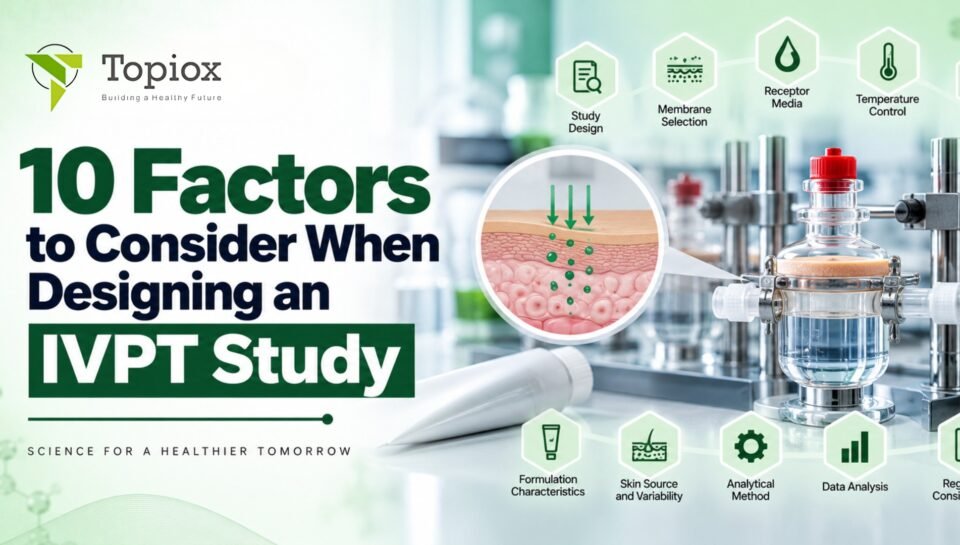
Successful IVPT study design depends on controlling experimental variability without removing the biological variability that makes human skin a meaningful model. The ten factors that deserve particular attention are:- Define the IVPT study objective.
- Select an appropriate skin source.
- Use multiple donors and a justified replicate strategy.
- Confirm skin-barrier integrity.
- Select and justify the receptor medium.
- Standardize dose and exposure conditions.
- Control diffusion-cell operating conditions.
- Design sampling around the permeation profile.
- Use fit-for-purpose bioanalytical methods.
- Plan the statistical analysis prospectively.
FAQ'S
There is no single most important variable. IVPT quality depends on the combined control of skin selection, donor variability, barrier integrity, dosing, receptor conditions, diffusion-cell operation, sampling, bioanalysis, and statistics.
The appropriate number depends on the study objective, variability, endpoints, and regulatory strategy. Pilot studies can help estimate donor requirements for a later pivotal comparative study. FDA educational materials have described multi-donor pilot designs for this purpose.
Human skin provides a biologically relevant barrier for studying cutaneous drug permeation and is commonly used to evaluate topical pharmacokinetics.
The receptor medium must accommodate the permeated drug without materially altering the skin barrier. Certain additives can change drug solubility or even skin permeability, so receptor-medium composition requires scientific justification.
Depending on the study and regulatory strategy, relevant endpoints may include cumulative amount permeated and flux-related parameters. FDA product-specific materials have used endpoints such as total cumulative amount and maximum flux for certain topical products.
IVPT is a type of in vitro skin permeation study designed to characterize drug transport through excised skin under controlled conditions. The exact sample fractions and endpoints depend on the study purpose.
For certain topical products and regulatory strategies, appropriately developed and validated IVPT studies may contribute to a characterization-based BE approach alongside other evidence. FDA’s current general IVPT guidance remains draft guidance and should be interpreted together with the applicable product-specific guidance.
Pilot studies can be highly valuable for confirming experimental conditions, evaluating variability and method discrimination, and informing donor or replicate requirements before pivotal testing.