u300951854_demo

  • Home
  • Author: u300951854_demo
  • Page 2

u300951854_demo

Pharmaceutical Polymer Synthesis for Controlled-Release Drug Delivery

Pharmaceutical Polymer Synthesis for Controlled-Release Drug Delivery

In controlled drug delivery, product performance depends as much on polymer behaviour as on the active ingredient itself. A drug may have the right pharmacology, but if the surrounding material system is not designed properly, the formulation may still fail to achieve its intended release profile, stability target, or therapeutic performance. This is where pharmaceutical […]
Continue Reading
How Excipient Design Shapes Stability and Drug Delivery

How Excipient Design Shapes Stability and Drug Delivery

In many pharmaceutical products, formulation success depends as much on excipient design as on the active ingredient itself. A drug candidate may show strong therapeutic potential yet still fail because the surrounding formulation environment is not designed to support its target quality and performance profile. This is where excipients become critically important. They do far […]
Continue Reading
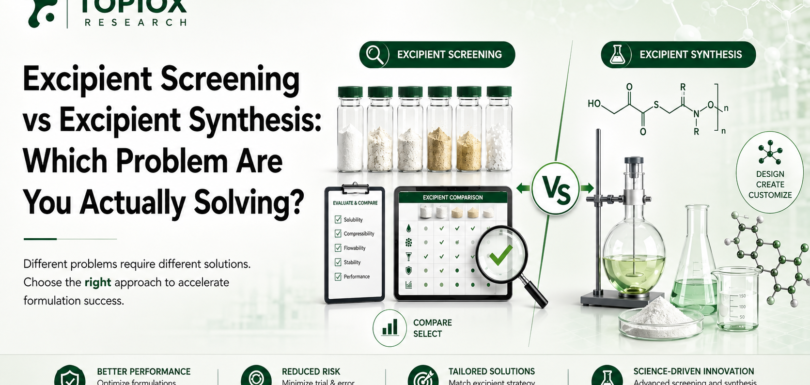
Custom Excipient Synthesis for Complex Drug Formulations

Custom Excipient Synthesis for Complex Drug Formulations

Many promising drug candidates fail in formulation not because of weak pharmacology, but because standard excipients cannot support their development requirements. Modern pharmaceutical pipelines increasingly include molecules with poor aqueous solubility, low physical or chemical stability, limited bioavailability, incompatible processing behavior, or delivery constraints that conventional formulation systems struggle to address. In these cases, the […]
Continue Reading
Why Headspace GC-MS Matters in Volatile Impurity Analysis for Pharma Quality and Compliance

Why Headspace GC-MS Matters in Volatile Impurity Analysis for Pharma Quality and Compliance

Volatile impurities may be present in small amounts, but their impact on pharmaceutical quality can be serious. They can affect product safety, stability, odour, purity profile, and regulatory acceptability. In some cases, they may also indicate process inefficiencies, contamination risks, material compatibility issues, or incomplete solvent removal. That is why volatile impurity analysis is an […]
Continue Reading
Residual Solvent Testing by Headspace GC-MS: A Practical Guide for Pharma Teams

Residual Solvent Testing by Headspace GC-MS: A Practical Guide for Pharma Teams

Residual solvents may be present in very small amounts, but their impact on pharmaceutical quality can be significant. They can affect product safety, impurity profiles, stability, regulatory acceptability, and batch release decisions. That is why residual solvent testing by Headspace GC-MS remains a critical part of pharmaceutical analysis. For pharma teams involved in development, quality […]
Continue Reading
How Elemental Impurities Testing Supports ICH Q3D Compliance

How Elemental Impurities Testing Supports ICH Q3D Compliance

Elemental impurities may be present at trace levels, but in pharmaceutical products they can create significant safety, quality, and regulatory risk. These impurities can come from raw materials, catalysts, excipients, manufacturing equipment, container systems, or process-related contamination. That is why elemental impurities testing has become an important part of modern pharmaceutical quality control. It is […]
Continue Reading
Common Sources of Extractables and Leachables in Pharmaceutical Packaging Systems

Common Sources of Extractables and Leachables in Pharmaceutical Packaging Systems

Pharmaceutical packaging does more than contain a product. It directly influences product protection, shelf life, and contamination risk. Packaging materials are designed to preserve formulation quality, support stability, and protect the product throughout storage and use. But they can also introduce chemical risk. Materials used in containers, closures, liners, tubing, seals, and other packaging-associated components […]
Continue Reading