
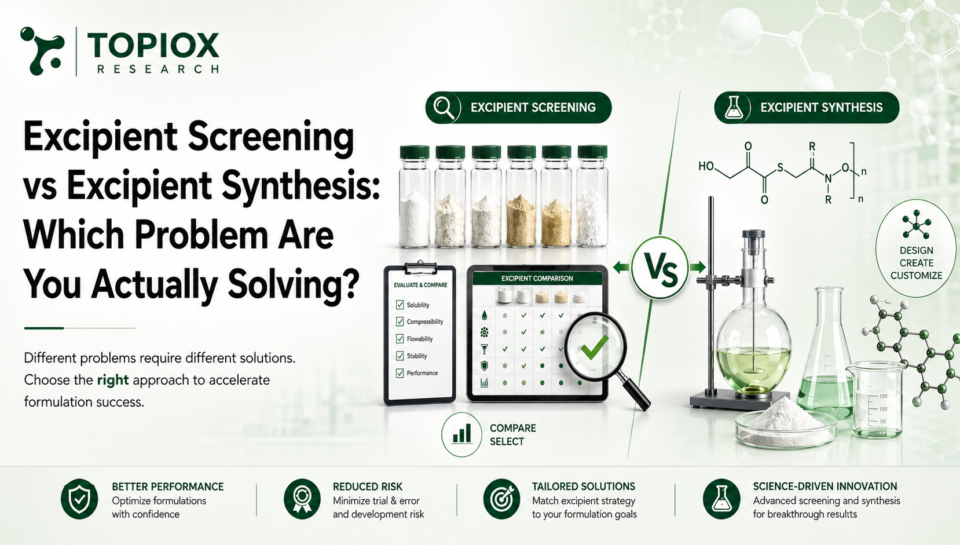
Excipients play a fundamental role in pharmaceutical formulation development, influencing manufacturability, stability, drug release, bioavailability, patient acceptability, and overall product performance. Although many pharmaceutical products can be successfully developed using commercially available excipients, certain formulation challenges cannot always be resolved through conventional excipient selection alone.
When formulation performance does not meet predefined development objectives, scientists are often faced with an important decision: should existing excipients be screened more systematically, or is custom excipient synthesis required to address the underlying problem?
While these approaches are sometimes viewed as alternatives, they serve different scientific purposes. Excipient screening focuses on identifying the most suitable material from available options, whereas excipient synthesis involves designing or modifying excipient properties to achieve specific formulation objectives that cannot be met using existing materials.
Understanding when each approach is appropriate helps reduce development risk, improve formulation efficiency, and support scientifically justified product design.
At Topiox Research Centre, excipient evaluation is considered a strategic component of pharmaceutical formulation development, where scientific decision-making begins with understanding the formulation challenge before selecting the appropriate development approach.
When Do You Need Excipient Screening Instead of Custom Excipient Synthesis?
Excipient screening is appropriate when commercially available excipients can potentially meet formulation requirements through systematic evaluation of their functional properties. Custom excipient synthesis may become necessary when existing excipients cannot adequately address formulation challenges related to stability, solubility, controlled drug release, manufacturability, compatibility, or other product-specific performance requirements.
Quick Takeaway
The decision is not based on whether a new excipient can be developed, it is based on whether existing excipients can achieve the required formulation performance. Screening optimizes material selection, while synthesis addresses limitations that cannot be overcome through available excipient options.
Why Excipient Selection Matters
Excipients influence numerous aspects of pharmaceutical performance, including:
- Drug stability
- Solubility enhancement
- Dissolution
- Controlled drug release
- Powder flow
- Tablet compression
- Moisture protection
- Patient acceptability
- Manufacturing efficiency
Selecting the appropriate excipient therefore requires consideration of both functional performance and compatibility with the active pharmaceutical ingredient (API).
What Is Excipient Screening?
Excipient screening is a systematic evaluation of commercially available excipients to determine which material or combination of materials best supports the intended formulation objectives.
Typical screening studies evaluate:
- Solubility enhancement
- Compatibility
- Flowability
- Compressibility
- Moisture sensitivity
- Stability
- Dissolution behaviour
- Drug release characteristics
The objective is to identify the most appropriate excipient without altering its chemical structure.
What Is Custom Excipient Synthesis?
Custom excipient synthesis involves designing, modifying, or developing excipients with specific physicochemical or functional characteristics that are not adequately provided by existing commercially available materials.
Depending on the development objective, excipient synthesis may involve modifying particle properties, chemical functionality, surface characteristics, or polymer architecture to achieve desired formulation performance.
Because custom excipient development introduces additional scientific, manufacturing, and regulatory considerations, it is generally pursued only when conventional excipient screening cannot satisfactorily resolve the formulation challenge.
Excipient Screening vs Excipient Synthesis
Although both approaches support formulation development, they address different scientific questions.
Excipient screening seeks to determine whether existing excipients can achieve the desired formulation performance through systematic evaluation and optimization.
Excipient synthesis seeks to create or modify an excipient when existing materials cannot provide the required functional characteristics.
Rather than competing approaches, they represent different stages within a risk-based formulation development strategy.
When Excipient Screening Is Usually Sufficient
Excipient screening is often appropriate when:
- Multiple approved excipients are available.
- The formulation challenge relates to optimization rather than material limitations.
- Stability issues appear manageable through excipient selection.
- Drug release can be adjusted using existing technologies.
- Manufacturing performance can be improved through formulation optimization.
In many pharmaceutical development programs, systematic screening identifies suitable excipients without requiring custom synthesis.
When Custom Excipient Synthesis May Be Considered
Custom excipient synthesis may be scientifically justified when:
- Existing excipients cannot achieve target formulation performance.
- Novel controlled-release behaviour is required.
- Stability challenges remain unresolved after formulation optimization.
- Solubility enhancement requires new material functionality.
- Drug delivery objectives cannot be achieved using commercially available excipients.
- Specialized dosage forms require unique material properties.
Such decisions should be supported by comprehensive formulation studies, compatibility assessments, and risk evaluation.
Factors Influencing the Decision
The choice between excipient screening and synthesis depends on several scientific considerations:
API Characteristics
Physicochemical properties, stability, solubility, and compatibility.
Formulation Objectives
Immediate release, modified release, topical delivery, or other dosage form requirements.
Manufacturing Considerations
Processability, scalability, robustness, and reproducibility.
Regulatory Expectations
Use of established excipients generally simplifies development, whereas novel excipients may require additional characterization and supporting data.
Development Timeline
Screening existing excipients is typically faster than developing new excipient materials.
Topiox Framework for Excipient Development Decisions
At Topiox Research Centre, excipient evaluation can be approached through four interconnected scientific considerations.
1. Define the Formulation Challenge
Clearly identify whether the limitation relates to stability, manufacturability, drug release, solubility, compatibility, or another critical quality attribute.
2. Evaluate Existing Excipients
Assess commercially available excipients through systematic screening studies before considering material modification.
3. Assess Scientific Feasibility
Determine whether formulation objectives can realistically be achieved using existing materials or whether new excipient functionality may be required.
4. Support Evidence-Based Development
Integrate analytical characterization, compatibility studies, stability data, and formulation performance to support scientifically justified decision-making.
This structured framework helps ensure that excipient synthesis is considered only when screening studies demonstrate that commercially available materials are insufficient.
Practical Example
Consider the development of a poorly water-soluble oral drug product.
Initial formulation studies evaluate multiple commercially available polymers and solubilizing agents through structured excipient screening. Although several excipients improve dissolution, none provide the desired balance of stability, release profile, and manufacturability.
Following a comprehensive assessment, the development team determines that additional material modification may be necessary to achieve the target product profile.
This example illustrates how systematic screening informs the decision to explore custom excipient development rather than assuming a novel excipient is required from the outset.
Regulatory Perspective
Regulatory agencies generally encourage the use of scientifically justified and well-characterized excipients during pharmaceutical development. Existing excipients with established safety and quality profiles often simplify development and regulatory review. When custom or novel excipients are considered, additional characterization, safety evaluation, manufacturing controls, and supporting documentation may be required to demonstrate their suitability for pharmaceutical use.
How Topiox Research Centre Supports Excipient Evaluation
Important: Only include this section if it reflects your actual services.
If your website offers excipient synthesis, you can write:
At Topiox Research Centre, formulation development is supported through excipient screening, physicochemical characterization, compatibility assessment, and scientific evaluation of formulation performance. Where development objectives cannot be achieved using conventional materials, our research capabilities may also support the investigation of custom excipient approaches as part of broader formulation development programs.
If you do not offer custom excipient synthesis, avoid claiming that you do.
Faq's
Excipient screening is the systematic evaluation of commercially available excipients to identify materials that best support formulation performance.
Custom excipient synthesis involves developing or modifying excipients with specific functional properties when existing materials cannot adequately address formulation challenges.
No. Most pharmaceutical formulations can be successfully developed using systematic screening and optimization of approved excipients.
They may be considered when existing excipients cannot achieve the required stability, solubility, drug release, or manufacturing performance.
Screening existing excipients helps determine whether commercially available materials can meet formulation objectives before more complex development strategies are pursued.
Appropriate excipient selection influences stability, manufacturability, dissolution, drug release, bioavailability, and overall product quality.