What Is Cleaning Validation in Pharmaceutical Manufacturing?
Cleaning validation is the documented demonstration that an established cleaning procedure can consistently remove product residues, cleaning-agent residues, microbial contamination where relevant, and other unwanted materials from pharmaceutical equipment to predefined acceptable levels. It connects several disciplines: Product knowledge → Cross-contamination risk assessment → Cleaning procedure → Sampling → Analytical testing → Acceptance criteria → Documented evidence This makes cleaning validation particularly relevant in facilities where equipment, utensils, manufacturing lines, or laboratory systems are used for multiple products. Research on pharmaceutical cleaning validation consistently emphasizes its role in preventing carryover and demonstrating that cleaning processes perform reproducibly.Why Cleaning Validation Matters to Formulation Development Teams
Cleaning validation is sometimes treated as primarily a manufacturing or Quality Assurance responsibility. That view is incomplete. Formulation scientists influence many of the variables that ultimately determine how difficult a product is to remove from manufacturing equipment. Consider two formulations. One is a freely water-soluble solution. The other is a high-viscosity ointment containing poorly soluble ingredients. Even when both are processed using similar equipment, their cleaning challenges may be completely different. A formulation’s:- API solubility,
- potency,
- toxicity,
- viscosity,
- adhesion,
- excipient composition,
- oil content,
- polymer content,
- surfactant system,
- and physical state
Cross-Contamination Risk: Why “Visually Clean” Is Not Enough
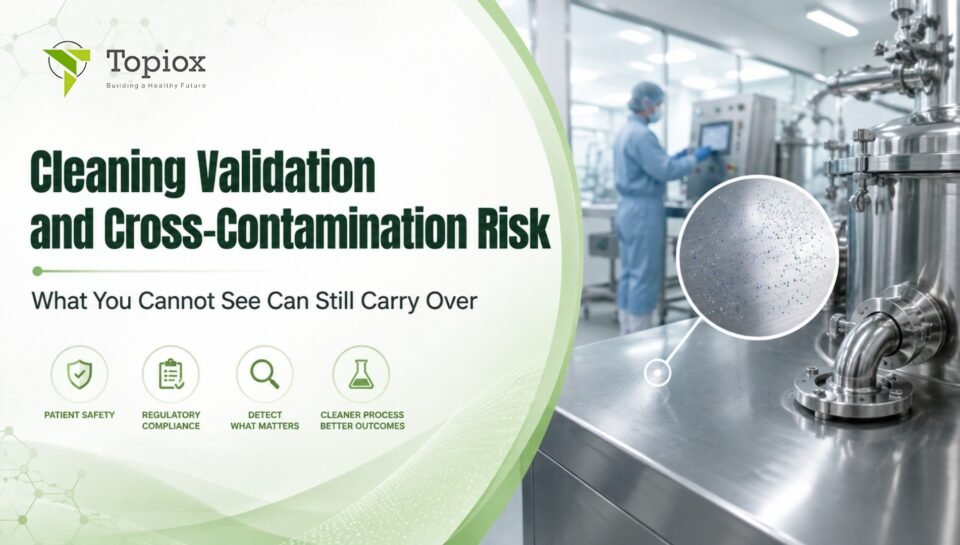
Visual inspection is valuable, but it cannot independently establish the absence of trace chemical residues. A surface may appear clean while still containing residual API at concentrations that require analytical evaluation. This creates a critical distinction: Visual cleanliness ≠ demonstrated analytical cleanliness Cross-contamination can occur when residues from one product are transferred into another product manufactured or analyzed using shared equipment. Potential residues may include:- active pharmaceutical ingredients,
- potent compounds,
- excipients,
- detergents and cleaning agents,
- degradation products,
- intermediates,
- microorganisms,
- and process-related contaminants.
Where Residues Hide: Understanding Hard-to-Clean Equipment Areas
One reason cleaning validation is challenging is that equipment surfaces are rarely equally accessible. Residues may accumulate in locations such as:- valves,
- gaskets,
- seals,
- transfer lines,
- bends,
- joints,
- mixing blades,
- filling nozzles,
- dead legs,
- corners,
- textured surfaces,
- and difficult-to-access product-contact areas.
Why Formulation Properties Determine Cleaning Difficulty
Cleaning difficulty is product-specific. Several formulation characteristics can make residues harder to remove.Poor Solubility
Poorly water-soluble APIs may not be adequately removed by water-based cleaning alone.High Potency
Potent APIs may require very low carryover limits, increasing the sensitivity required from the cleaning procedure and analytical method.High Viscosity
Creams, ointments, gels, and polymer-rich systems can adhere strongly to equipment surfaces.Lipophilic Components
Oils, waxes, petrolatum-type materials, and other hydrophobic excipients may resist conventional aqueous cleaning.Pigments and Strongly Adherent Materials
Visible pigments can sometimes indicate cleaning difficulty, but colorless compounds may be equally important from a carryover perspective.Product Drying
Residues that remain on equipment for extended periods may become harder to remove. This is why formulation scientists can provide valuable information during cleaning risk assessment and worst-case product selection.Worst-Case Product Selection: A Critical Development Decision
It is often impractical to treat every product as an entirely independent cleaning-validation challenge. A scientifically justified worst-case approach can help prioritize products that present the greatest cleaning or carryover challenge. Worst-case selection may consider factors such as:- potency,
- toxicity,
- solubility,
- cleanability,
- batch size,
- formulation composition,
- equipment contact,
- residue characteristics,
- and allowable carryover.
Cleaning Validation and Maximum Allowable Carryover
One of the central questions in cleaning validation is: How much residue can remain before it creates an unacceptable carryover risk? Acceptance criteria should be scientifically justified rather than selected simply because an analytical instrument can detect a particular concentration. A robust approach links residue limits to the broader contamination-control and toxicological strategy applicable to the product and facility. The analytical method must then be capable of measuring residues at concentrations relevant to the established acceptance criterion. This creates a logical sequence: Risk assessment → Acceptance limit → Sampling strategy → Analytical capability → Validation evidence Studies of pharmaceutical equipment cleaning have used maximum allowable carryover concepts alongside swab and rinse sampling to verify whether cleaning procedures adequately control residual drug substances.Swab Sampling vs Rinse Sampling in Cleaning Validation
Sampling is one of the most important components of a cleaning-validation study. Two commonly used approaches are swab sampling and rinse sampling.Swab Sampling
Swab sampling collects residues directly from a defined equipment surface. It can be particularly useful for evaluating:- specific product-contact locations,
- suspected worst-case areas,
- hard-to-clean surfaces,
- and localized residue.
Rinse Sampling
Rinse sampling evaluates material recovered through a defined rinse procedure. It can provide information about larger or less accessible systems where direct swabbing is difficult. However, rinse results may represent an average across a larger area and may not identify localized residue hotspots. Neither method is automatically superior. The sampling strategy should reflect the equipment design, residue properties, analytical objective, and identified risk. Studies evaluating cleaning residues have successfully applied both swab and rinse approaches across different equipment and surface types.Why Recovery Studies Matter
Finding no residue in a swab sample does not automatically mean the surface was residue-free. It could also mean that the sampling procedure failed to recover the residue effectively. This is why recovery studies are important. Recovery studies assess whether the selected sampling material, solvent, technique, and extraction process can recover a known amount of residue from representative surfaces. These surfaces may include:- stainless steel,
- glass,
- polymers,
- PTFE,
- or other product-contact materials.
Analytical Method Sensitivity: Can You Measure What Matters?
Cleaning validation requires more than a cleaning procedure. It requires an analytical method capable of demonstrating whether residues meet the established criterion. Depending on the target residue and strategy, techniques may include:- HPLC,
- UHPLC,
- UV spectroscopy,
- total organic carbon (TOC),
- conductivity,
- or other appropriately justified methods.
Cleaning Validation Matters in QC Laboratories Too
Cross-contamination control does not end at the manufacturing floor. QC laboratories may use shared:- glassware,
- vessels,
- stainless-steel equipment,
- sampling tools,
- and analytical preparation equipment.
Dirty Hold Time: Why Time Before Cleaning Matters
Cleaning effectiveness can change depending on how long equipment remains dirty before the cleaning procedure begins. A fresh residue may be relatively easy to remove. The same residue may become more difficult to clean after:- drying,
- crystallization,
- polymer hardening,
- solvent evaporation,
- or prolonged surface contact.
What Happens When Cleaning Validation Is Weak?
Weak cleaning controls can create consequences beyond a failed swab result. Potential outcomes include:- cross-contamination,
- unexpected analytical results,
- batch investigations,
- repeat cleaning,
- manufacturing delays,
- deviation investigations,
- regulatory observations,
- product-quality concerns,
- and increased patient-safety risk.
Cleaning Validation as Part of Formulation Developability
Cleaning is rarely the first property considered when designing a formulation. But it should not be the last. During development, teams should consider questions such as:- Does the formulation adhere strongly to stainless steel?
- Does the API have poor aqueous solubility?
- Do oily excipients leave persistent films?
- Does the formulation dry rapidly onto surfaces?
- Are polymers or gelling agents difficult to remove?
- Does the product contain highly potent compounds?
- Can the proposed cleaning agent remove both API and formulation residues?
- Could the formulation become harder to clean after a defined dirty hold time?
Cleaning Validation Within a Pharmaceutical Lifecycle
Cleaning validation should not be treated as a document created once and then forgotten. Products, processes, equipment, and cleaning procedures can change. A lifecycle-oriented strategy considers cleaning performance during: Development → Scale-up → Technology transfer → Process validation → Commercial manufacturing → Change control Changes that may require reassessment include:- new products introduced into shared equipment,
- formulation changes,
- equipment modifications,
- cleaning-agent changes,
- process changes,
- new manufacturing sequences,
- and revised toxicological information.
Best Practices for Cleaning Validation and Cross-Contamination Control
Begin With Risk Assessment
Identify the products, residues, surfaces, and manufacturing sequences that create the greatest potential carryover risk.Understand Formulation Cleanability
Include solubility, viscosity, potency, adhesion, excipients, and drying behavior when evaluating cleaning difficulty.Select Worst Cases Scientifically
Worst-case selection should be justified using product and process knowledge rather than convenience alone.Establish Meaningful Acceptance Criteria
Residue limits should connect to the relevant scientific and toxicological risk framework.Choose Representative Sampling Locations
Include areas most likely to retain residue, not simply surfaces that are easiest to reach.Demonstrate Sampling Recovery
Confirm that the sampling method can recover residues from representative equipment surfaces.Use Fit-for-Purpose Analytical Methods
The method should have appropriate sensitivity, selectivity, accuracy, precision, and robustness for the intended residue limit.Consider Hold Times and Process Conditions
Validate cleaning under realistic and appropriately challenging operating conditions. At topiox research, cleaning-validation analytical support can be approached as part of a broader pharmaceutical development and quality strategy connecting formulation characteristics, residue behavior, analytical capability, and cross-contamination risk.Conclusion
In pharmaceutical manufacturing, what cannot be seen can still carry over. That is why cleaning validation must go beyond visual inspection. A scientifically robust program connects formulation properties, cross-contamination risk, worst-case selection, acceptance criteria, sampling recovery, analytical sensitivity, equipment design, and process conditions to demonstrate that cleaning procedures perform consistently. For formulation development teams, this has an additional implication: cleanability is part of manufacturability. Understanding residue behavior early can help identify potential scale-up and shared-equipment risks before they become expensive manufacturing or compliance problems. For QC teams, validated cleaning approaches can also help protect analytical integrity where shared equipment and laboratory materials are used. At topiox research, the objective is to connect analytical science with practical pharmaceutical development and quality requirements so that cleaning-validation data provide meaningful evidence of contamination control rather than simply completing a compliance exercise.FAQ'S
Cleaning validation matters because formulation properties such as API solubility, viscosity, potency, excipient composition, and adhesion can determine how easily product residues are removed from manufacturing equipment.
Yes. Visual inspection can identify visible contamination, but trace residues may require suitable analytical sampling and testing to demonstrate that established acceptance criteria have been met.
Cross-contamination occurs when a material or product becomes contaminated by another material or product, including through residues remaining on shared manufacturing equipment.
Worst-case selection identifies products or processes that present particularly challenging cleaning or carryover risks based on scientifically relevant factors such as potency, toxicity, solubility, cleanability, and equipment exposure.
Swab sampling directly assesses defined surfaces, while rinse sampling collects residues through a rinse procedure and can help assess systems or areas that may be difficult to swab directly.
Recovery studies demonstrate whether the sampling and extraction procedure can reliably recover a known amount of residue from representative equipment surfaces.
Cleaning controls can also be relevant to QC laboratories where shared glassware or equipment could retain residues and potentially interfere with subsequent testing.