
- a much higher concentration of active pharmaceutical ingredient (API);
- multiple excipients;
- process impurities;
- degradation products;
- solvents;
- and other matrix components.
Why Does Nitrosamine Method Sensitivity Matter?
Nitrosamine method sensitivity matters because the analytical procedure must be capable of detecting and, where required, quantifying the target impurity at a level appropriate to its acceptable intake and the drug product’s maximum daily dose. Conceptually: Applicable acceptable intake ↓ Maximum daily dose ↓ Required concentration limit in the drug substance or drug product ↓ Required analytical sensitivity ↓ Method development and validation This means the analytical target should be established from the safety/control requirement. The process should not be reversed: Instrument detection capability → arbitrary reporting limit Instead: Safety-based requirement → analytical target → method capability This is particularly important for nitrosamines because acceptable daily exposures can translate into very low concentrations in high-dose pharmaceutical products.Sensitivity Alone Is Not Enough
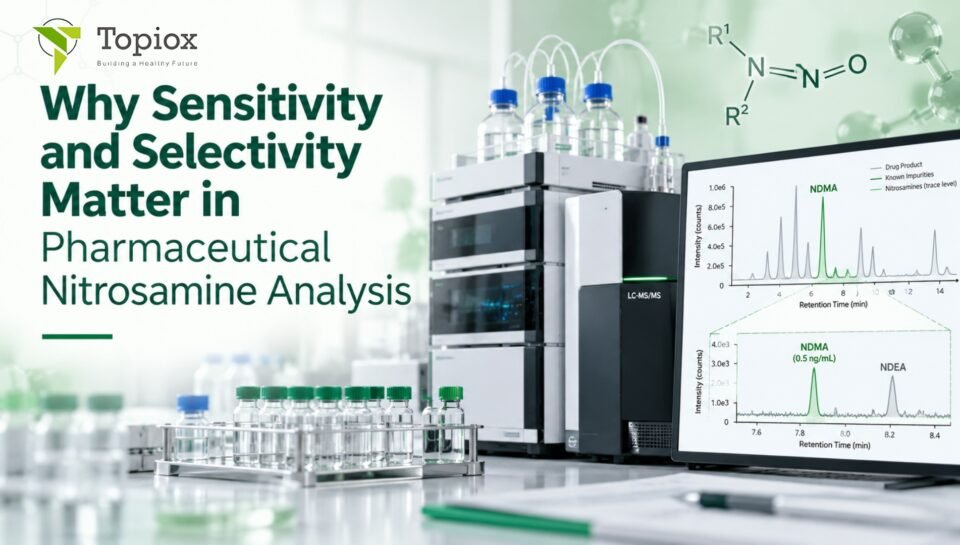
Suppose an LC-MS/MS method can produce a measurable signal corresponding to 0.1 ng/mL. That sounds impressive. But what if a formulation component produces a signal at the same retention time and monitored transition? Or what if the API suppresses ionization so that the nitrosamine response varies substantially between standards and samples? Or what if the nitrosamine forms during sample preparation? The instrument may be sensitive enough to detect the signal while the overall analytical result remains unreliable. This gives a useful principle: Sensitivity determines how little can be measured. Selectivity helps determine whether what is being measured is actually the intended analyte. Reliable nitrosamine analysis requires both.What Does Selectivity Mean in Nitrosamine Analysis?
Selectivity is the ability of an analytical procedure to measure the target nitrosamine accurately in the presence of other components expected in the sample. Potential interferences include:- API;
- excipients;
- API degradants;
- process impurities;
- solvents;
- structurally related compounds;
- other nitrosamines;
- sample-preparation reagents;
- and instrumental artifacts.
Why Acceptable Intake and Maximum Daily Dose Drive Method Sensitivity
Nitrosamine limits are fundamentally exposure-based. For a simplified illustration: Allowable concentration ≈ Acceptable daily intake ÷ Maximum daily product dose Therefore, if two products have the same applicable acceptable intake but different maximum daily doses, they may require very different analytical concentration limits. A high-dose product can require a lower analytical reporting or quantitation level. This means: The same nitrosamine does not automatically require the same method sensitivity in every drug product. The method should be developed against the product-specific analytical target derived using the current applicable regulatory limit and dosing scenario. This is especially important because acceptable intake recommendations for nitrosamines and NDSRIs continue to evolve as new toxicological and structural information becomes available.LOD and LOQ: Important but Different
Two common analytical parameters are the:- Limit of Detection (LOD)
- Limit of Quantitation (LOQ)
Limit of Detection
The LOD relates to the lowest level at which the analyte can be reliably distinguished from background under defined analytical conditions.Limit of Quantitation
The LOQ relates to a level at which the analyte can be quantitatively measured with suitable analytical performance. For a regulatory control question, simply demonstrating that an impurity is detectable may not be sufficient. If a quantitative result must be compared with an acceptable concentration limit, the method generally needs appropriate quantitative performance around the relevant level. Therefore: LOD tells you whether you can see it. LOQ helps establish whether you can measure it appropriately. The relevant method capability should be justified for the intended use.Why High-Dose Drug Products Can Be Analytically Challenging
Consider a simplified example. Two products have the same applicable nitrosamine acceptable intake.Product A
Maximum daily dose: relatively low.Product B
Maximum daily dose: much higher. Because Product B exposes the patient to more drug product each day, the nitrosamine concentration corresponding to the same daily intake may need to be lower. Therefore: Higher maximum daily dose → potentially lower required nitrosamine concentration limit This can create substantial analytical challenges. The method may need to quantify a trace impurity while the API concentration remains many orders of magnitude higher. That concentration imbalance can contribute to:- detector saturation;
- ion suppression;
- chromatographic interference;
- contamination;
- carryover;
- and reduced recovery.
Matrix Effects Can Undermine Apparent Sensitivity
A method may show excellent sensitivity in neat solvent standards but perform very differently in the actual pharmaceutical matrix. This is particularly relevant to mass spectrometry. In LC-MS analysis, coeluting matrix components can alter analyte ionization. This can result in: Ion suppression or Ion enhancement If the response is suppressed, a nitrosamine present at the target concentration may generate a weaker signal than expected. If the response is enhanced, the reported concentration could be biased in the opposite direction. Recent analysis of NDSRI methodology identifies matrix interference and ion suppression as major challenges when measuring ultra-trace impurities in the presence of high API and excipient concentrations. Therefore: Solvent sensitivity ≠ matrix sensitivity Method performance must be demonstrated in a representative matrix.Selectivity Can Be as Important as Instrument Sensitivity
Modern mass spectrometers can detect extremely small amounts of material. But lowering the instrumental detection limit does not automatically improve analytical reliability. If an interference produces the same or similar analytical response, increased sensitivity may simply make the interference easier to detect. This is why chromatographic separation remains important even with advanced mass spectrometry. A 2025 study of NDMA in metformin formulations demonstrated how dimethylformamide (DMF) could complicate NDMA analysis through analytical interference, coelution, and ionization effects, and showed the importance of methods capable of distinguishing NDMA in the presence of DMF. The lesson extends beyond metformin: A low detection limit cannot compensate for poor analyte discrimination.Chromatographic Separation Matters
Mass spectrometry is highly selective, but chromatography still performs essential work. Adequate separation can reduce:- matrix effects;
- ion suppression;
- isobaric interference;
- coeluting impurities;
- false positives;
- and quantitation bias.
Why LC-MS/MS Is Commonly Used
LC-MS/MS is particularly useful for many nitrosamines and NDSRIs because it combines:- chromatographic separation;
- molecular-ion selection;
- fragmentation;
- and selective product-ion monitoring.
- retention time;
- qualifier transitions;
- ion ratios;
- chromatographic resolution;
- isotope-labelled internal standards;
- and matrix-specific interference studies.
When Can LC-HRMS Be Useful?
High-resolution mass spectrometry can provide accurate-mass information that helps distinguish compounds with similar nominal masses. LC-HRMS can be particularly useful for:- impurity identification;
- NDSRI characterization;
- screening;
- confirmation;
- structural investigation;
- and resolving complex interference problems.
- appropriate sample preparation;
- chromatographic separation;
- reference materials where available;
- recovery assessment;
- and suitable quantitative performance.
When Can GC-MS Be Useful?
GC-based techniques can be highly effective for volatile and semivolatile nitrosamines. Depending on the target impurity and matrix, approaches may include:- GC-MS;
- GC-MS/MS;
- headspace GC-MS;
- and other selective detection configurations.
The False-Positive Problem: Artifactual Nitrosamine Formation
Perhaps one of the most important reasons selectivity alone is insufficient is that the analytical procedure can potentially create the analyte being measured. If a sample contains:- a nitrosatable amine;
- nitrite;
- and conditions favorable for nitrosation,
- extraction;
- sample storage;
- heating;
- GC inlet conditions;
- chromatographic analysis;
- or other analytical steps.
False Negatives Matter Too
False positives are not the only concern. A method can also underestimate or miss a nitrosamine because of:- poor extraction recovery;
- analyte degradation;
- adsorption;
- volatility losses;
- ion suppression;
- insufficient chromatographic retention;
- unsuitable ionization;
- matrix interference;
- or instability during sample storage.
Sample Preparation Can Determine Method Performance
Nitrosamine sample preparation must often solve competing problems. It may need to:- extract the impurity efficiently;
- reduce API concentration;
- remove interfering excipients;
- preserve analyte stability;
- prevent artifactual formation;
- and remain reproducible.
- direct extraction;
- dilution;
- liquid-liquid extraction;
- solid-phase extraction;
- headspace approaches;
- and other matrix-specific procedures.
- target nitrosamine;
- volatility;
- polarity;
- API properties;
- formulation;
- required sensitivity;
- and analytical platform.
Recovery Must Be Evaluated at Relevant Levels
Recovery experiments help answer: If the nitrosamine is actually present in this drug product, does the analytical procedure recover and measure it correctly? This should be evaluated in the relevant matrix. Recovery can be affected by:- incomplete extraction;
- adsorption;
- sample losses;
- chemical instability;
- filtration;
- evaporation;
- and matrix effects.
Why Isotope-Labelled Internal Standards Can Help
Where available and appropriate, isotope-labelled internal standards can strengthen quantitative mass-spectrometric methods. A suitable labelled analogue may compensate for variability associated with:- extraction;
- injection;
- ionization;
- matrix suppression;
- and instrument response.
- unresolved chromatographic interference;
- analyte formation during preparation;
- analyte degradation before the internal standard is added;
- or inappropriate method selectivity.
NDSRIs Create Additional Analytical Challenges
Nitrosamine drug substance-related impurities can be considerably more difficult to analyze than small volatile nitrosamines. NDSRIs may:- be structurally similar to the API;
- be nonvolatile;
- have limited commercial reference-standard availability;
- produce complex fragmentation;
- exhibit isomeric behavior;
- occur at extremely low concentrations;
- and coexist with very high concentrations of the parent drug.
Reference Standards Matter
Accurate quantitative analysis is strongest when a well-characterized authentic reference standard is available. Reference standards support:- retention-time confirmation;
- spectral comparison;
- calibration;
- recovery studies;
- method validation;
- and quantitative accuracy.
Sensitivity Should Be Demonstrated in the Actual Matrix
A common development mistake is to establish LOD or LOQ using only solvent standards. A more meaningful demonstration considers: Standard response + matrix response + extraction recovery + interference + precision For example, a method may achieve: LOQ = X ng/mL in solvent but fail to provide comparable performance when analyzing:- a high-dose tablet;
- a complex suspension;
- a capsule containing multiple excipients;
- or another challenging dosage form.
What Makes a Nitrosamine Method Fit for Purpose?
A fit-for-purpose analytical procedure should answer the intended scientific and regulatory question. Depending on its intended use, important characteristics can include:- adequate sensitivity;
- selectivity/specificity;
- accuracy;
- precision;
- recovery;
- linearity or appropriate response model;
- range;
- matrix-effect understanding;
- robustness;
- carryover control;
- analyte stability;
- solution stability;
- and control of artifactual formation.
- method purpose;
- development phase;
- product;
- impurity;
- and applicable regulatory expectations.
A Practical Nitrosamine Method-Development Framework
A scientifically structured approach can follow:- Identify the target nitrosamine or NDSRI ↓ 2. Confirm the current applicable acceptable intake ↓ 3. Determine maximum daily dose ↓ 4. Calculate the required analytical concentration target ↓ 5. Understand analyte physicochemical properties ↓ 6. Understand the pharmaceutical matrix ↓ 7. Select an appropriate analytical platform ↓ 8. Develop sample preparation ↓ 9. Establish chromatographic selectivity ↓ 10. Optimize detection sensitivity ↓ 11. Investigate matrix effects and interference ↓ 12. Evaluate recovery and precision near the required level ↓ 13. Investigate potential artifact formation ↓ 14. Establish fit-for-purpose method performance ↓ 15. Apply the method to representative and stability samples where appropriate
Sensitivity vs Selectivity: A Practical Comparison
| Analytical Question | Sensitivity | Selectivity |
| Can the method detect a very small amount? | Primary concern | Supporting |
| Can it distinguish nitrosamine from API/excipients? | Not sufficient alone | Primary concern |
| Can it measure near the required control level? | Essential | Essential |
| Can it avoid matrix-related false positives? | Not sufficient alone | Essential |
| Can it address ion suppression? | Related | Related |
| Can it distinguish structurally related impurities? | Limited alone | Essential |
| Can it prove a signal is the intended analyte? | No | Critical |
| Is it enough by itself for reliable nitrosamine analysis? | No | No |
Common Problems in Pharmaceutical Nitrosamine Analysis
Chasing the Lowest Possible LOD
A lower LOD does not automatically produce a better method if the required analytical limit is already adequately supported.Insufficient Chromatographic Separation
Relying entirely on mass detection can leave unresolved matrix or isobaric interference.Ignoring Matrix Effects
Performance in solvent standards may overstate actual method capability.Poor Recovery
An instrument cannot detect analyte that never reaches the detector.Artifactual Nitrosamine Formation
The method can create the impurity during sample preparation or analysis.Carryover
Ultra-trace methods can be particularly vulnerable to contamination from previous high-level standards or samples.Inappropriate Reference Standards
Poor standard characterization can undermine quantitative accuracy.Assuming One Method Works for Every Nitrosamine
Small volatile nitrosamines and complex NDSRIs can require very different analytical approaches.Ignoring Sample Stability
The nitrosamine concentration can potentially change between sample preparation and analysis.Using an Outdated Acceptable Intake
Method sensitivity should be assessed against the current applicable limit for the specific nitrosamine.Best Practices for Sensitive and Selective Nitrosamine Analysis
Define the Analytical Target First
Start from the applicable acceptable intake and maximum daily dose.Match the Platform to the Analyte
Select GC- or LC-based analysis according to the target impurity’s physicochemical properties and matrix.Build Selectivity Into Chromatography
Do not rely exclusively on detector sensitivity.Evaluate Multiple Detection Dimensions
Use appropriate precursor/product ions, qualifier information, retention time, and accurate mass where applicable.Test the Actual Matrix
Demonstrate method capability in representative API or drug-product samples.Evaluate Matrix Effects
Especially for LC-MS-based methods.Assess Recovery at Relevant Levels
Include concentrations around the intended analytical limit.Control Carryover and Contamination
Ultra-trace methods require rigorous blanks and system controls.Investigate Artifact Formation
Demonstrate that sample preparation and analytical conditions do not create significant nitrosamine artificially.Use Suitable Internal Standards
Where scientifically appropriate, isotope-labelled standards can strengthen quantitative performance.Monitor Analyte and Sample Stability
Understand whether the measured concentration changes during analytical handling.Keep Regulatory Limits Current
Revisit method capability when acceptable intake recommendations change.Why “More Sensitive” Does Not Always Mean “Better”
Suppose the required quantitative limit for a particular product is 1 ng/mL. Method A reliably quantifies at 0.5 ng/mL with:- strong recovery;
- excellent chromatographic separation;
- minimal matrix effects;
- and good precision.
- poor recovery;
- significant ion suppression;
- unstable response;
- and unresolved interference.
Sensitivity and Selectivity at topiox research
Pharmaceutical nitrosamine analysis can require integration of:- acceptable-intake interpretation;
- product-dose calculations;
- nitrosamine chemistry;
- NDSRI characterization;
- LC-MS/MS;
- LC-HRMS;
- GC-MS/MS;
- headspace analysis;
- sample preparation;
- matrix-effect evaluation;
- trace-level method development;
- impurity identification;
- and stability investigations.
Conclusion
Reliable pharmaceutical nitrosamine analysis requires more than an instrument capable of detecting extremely small signals. A scientifically defensible method should integrate:- Applicable acceptable intake
- Maximum daily dose
- Required analytical concentration
- Sensitivity
- Selectivity
- Chromatographic separation
- Matrix-effect control
- Sample-preparation recovery
- Reference-standard strategy
- Artifact prevention
- Analyte and sample stability
- Fit-for-purpose method performance
FAQ'S
Nitrosamine acceptable intakes can translate into very low concentration limits, particularly for products with high maximum daily doses. The method must therefore provide adequate capability around the product-specific analytical target.
Sensitivity describes the ability to measure small amounts of an analyte. Selectivity describes the ability to distinguish the analyte from other substances in the sample.
LC-MS/MS can provide excellent sensitivity and selectivity for many nitrosamines and NDSRIs, but suitability depends on the specific analyte, matrix, required limit, sample preparation, and method performance.
Matrix components can suppress or enhance ionization and interfere with trace-level quantitation, potentially causing biased results.
Yes. Under certain conditions, nitrosatable amines and nitrite can react during sample preparation or even within an analytical system, creating artifactual nitrosamine.
No. The method should also demonstrate appropriate quantitative performance, selectivity, recovery, matrix control, precision, and other characteristics relevant to its intended purpose.
No. Method selection depends on the physicochemical properties of the target nitrosamine, matrix, sensitivity requirement, and potential analytical interferences.
NDSRIs can be structurally similar to the parent API, nonvolatile, present at ultra-trace levels, affected by complex matrices, and sometimes lack readily available reference standards.
The method should have sufficient demonstrated capability to support its intended decision at the applicable control level. Arbitrarily maximizing sensitivity below what is scientifically necessary can introduce additional analytical complexity without necessarily improving data quality.