Nitrosamine risk assessment has become a critical part of pharmaceutical impurity control.
Since nitrosamine impurities were first identified as a major regulatory concern in medicines, the scientific focus has expanded from well-known small-molecule nitrosamines such as NDMA and NDEA to a much broader range of potential impurities, including nitrosamine drug substance-related impurities (NDSRIs).
The challenge is that nitrosamines can arise through multiple routes.
They may originate from:
- API synthesis;
- residual amines;
- nitrosating agents;
- recovered solvents;
- contaminated raw materials;
- excipients containing trace nitrite;
- manufacturing conditions;
- degradation during storage;
- packaging-related interactions;
- or reactions involving the drug substance itself.
Published reviews consistently show that nitrosamine formation is not confined to API synthesis and may also occur during formulation, manufacturing, or storage of the finished drug product.
FDA’s current Control of Nitrosamine Impurities in Human Drugs guidance, revised in September 2024, recommends that manufacturers and applicants identify potential nitrosamine risks, perform confirmatory testing where a risk is identified, and implement controls or mitigation strategies when necessary. FDA distinguishes between small-molecule nitrosamines and NDSRIs.
The European Medicines Agency likewise maintains an evolving nitrosamine framework covering risk assessment, acceptable intake limits, the Carcinogenic Potency Categorisation Approach (CPCA), read-across, enhanced Ames testing, and mitigation strategies. EMA’s nitrosamine Q&A was at Revision 23 as of October 10, 2025, with its acceptable-intake appendix updated June 24, 2026.
For pharmaceutical development teams, the key question is therefore not simply:
“Do we detect a nitrosamine?”
It is:
“Is there a scientifically plausible pathway for nitrosamine formation, and if so, how should that risk be evaluated, tested, controlled, and monitored?”
At topiox research, nitrosamine risk assessment can be approached as an integrated exercise combining chemistry, formulation science, impurity analysis, toxicological interpretation, stability understanding, and regulatory strategy.
What Is a Pharmaceutical Nitrosamine Risk Assessment?
A pharmaceutical nitrosamine risk assessment is a structured scientific evaluation used to determine whether a drug substance, drug product, manufacturing process, excipient system, packaging configuration, or storage condition could generate or introduce nitrosamine impurities at potentially relevant levels.
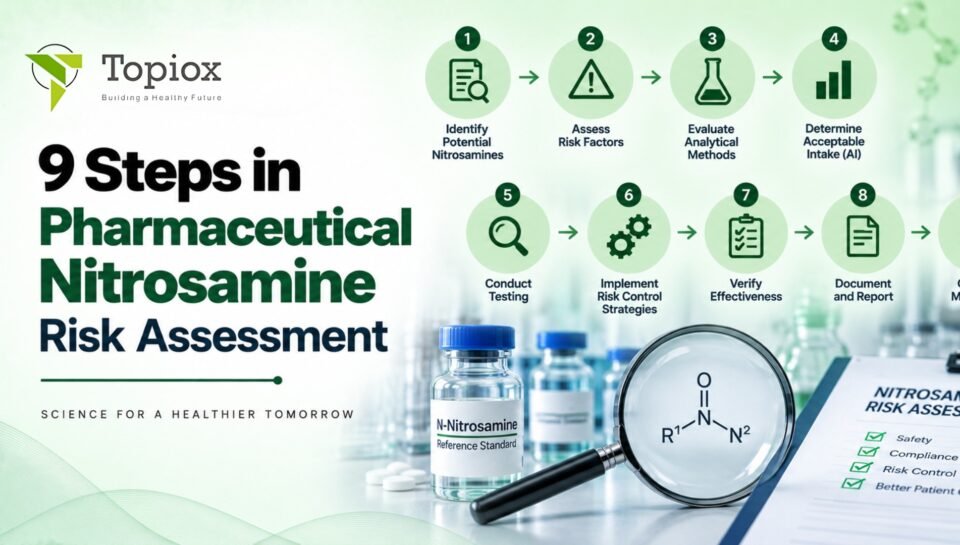
A practical risk-assessment sequence is:
Understand the drug substance and product
↓
Identify amine and nitrosating sources
↓
Map plausible nitrosamine formation pathways
↓
Evaluate process, excipient, and storage risks
↓
Identify potentially relevant nitrosamines or NDSRIs
↓
Determine applicable acceptable intake limits
↓
Perform confirmatory analytical testing where warranted
↓
Identify root cause
↓
Mitigate, control, and monitor the risk
FDA’s current framework follows the same broad logic: identify potential sources, conduct risk assessments, perform confirmatory testing when a risk is identified, and implement controls or mitigation strategies as needed.
Step 1: Understand the API and Drug Product Chemistry
A useful nitrosamine risk assessment begins with chemical understanding.
Developers should examine whether the API, intermediates, degradants, or formulation components contain structural features that could participate in nitrosation chemistry.
Important questions include:
- Does the API contain a secondary amine?
- Does it contain a tertiary amine that could generate a secondary amine?
- Could API degradation generate a nitrosatable amine?
- Are dimethylamine, diethylamine, or other low-molecular-weight amines present as residuals or degradants?
- Does the API contain structural features capable of forming an NDSRI?
- Could process intermediates or starting materials introduce amine functionality?
NDSRIs are especially important because they share structural similarity with the parent API and may form when a drug substance or API-related fragment undergoes nitrosation. FDA notes that NDSRIs can arise from nitrosation of APIs or API fragments containing certain amine centers.
Research examining NDSRIs such as N-nitroso derivatives of nortriptyline, sertraline, clonidine, beta blockers, and other APIs illustrates how API structure can directly determine the type of nitrosamine risk that must be assessed.
A risk assessment should therefore start from molecular structure, not from a generic nitrosamine checklist.
Step 2: Identify Nitrosating Agents and Nitrosamine Precursors
Nitrosamine formation generally requires a combination of:
Nitrosatable amine + Nitrosating species + Favorable reaction conditions
Potential sources of nitrosating species may include:
- nitrite impurities;
- nitrite-containing raw materials;
- residual process reagents;
- water systems;
- excipients containing trace nitrite;
- process streams;
- or degradation-related sources.
Potential amine precursors can arise from:
- APIs;
- intermediates;
- catalysts;
- solvents;
- raw materials;
- excipients;
- processing aids;
- or degradation products.
FDA specifically notes that nitrosamines may form through nitrosation reactions involving amines and nitrous acid generated from nitrite under suitable conditions.
Recent analytical research has also highlighted the value of measuring residual amine precursors in APIs as part of a broader nitrosamine risk-assessment strategy.
A meaningful assessment therefore considers both halves of the reaction:
Where could the amine come from?
and
Where could the nitrosating species come from?
Step 3: Map Potential Formation Pathways Across the Product Lifecycle
Nitrosamine risk is not confined to one manufacturing step.
The assessment should consider the complete lifecycle:
Raw materials
↓
API synthesis
↓
Isolation and purification
↓
Storage of drug substance
↓
Drug product formulation
↓
Manufacturing
↓
Packaging
↓
Stability and shelf life
Potential pathways can include:
- introduction of nitrosamines through contaminated materials;
- formation during API synthesis;
- reuse of recovered solvents;
- cross-contamination;
- amine/nitrite interactions during formulation;
- formation during drying or heating;
- reactions during long-term storage;
- and degradation-generated nitrosatable species.
Reviews of pharmaceutical nitrosamine contamination emphasize that nitrosamines can arise through both upstream synthetic routes and downstream drug-product pathways.
A risk assessment that looks only at the API manufacturing route may therefore miss important drug-product risks.
Step 4: Evaluate Excipients and Formulation Risk
Excipients can influence nitrosamine formation even when they are not themselves nitrosamines.
Potential concerns include:
- nitrite content;
- amine impurities;
- moisture;
- pH;
- excipient grade;
- batch-to-batch variability;
- and interactions with the API.
FDA specifically recognizes residual nitrite in excipients as a potential contributor to NDSRI formation in drug products.
This is particularly important when the API contains a nitrosatable amine.
For formulation teams, the risk question becomes:
Could the selected excipient system create the chemical environment required for nitrosation?
Factors such as:
- local pH;
- water activity;
- temperature;
- moisture uptake;
- excipient impurities;
- and drug–excipient proximity
can influence whether a theoretically possible pathway becomes practically relevant.
Risk assessment should therefore include formulation chemistry, not just supplier certificates.
Step 5: Assess Manufacturing and Process Conditions
A nitrosamine formation pathway may exist chemically but require specific processing conditions before it becomes important.
Potential process-related risk factors include:
- acidic conditions;
- elevated temperature;
- extended processing times;
- wet granulation;
- drying;
- solvent use;
- recycling or recovery of solvents;
- hold times;
- cleaning procedures;
- contamination from equipment or utilities;
- and sequence of ingredient addition.
The same API and excipients may show different nitrosamine outcomes when manufactured under different process conditions.
This is why a robust risk assessment asks:
Can the process bring the required precursors together under conditions favorable to nitrosamine formation?
Published reviews consistently identify manufacturing conditions and raw-material/process interactions as important sources of nitrosamine contamination.
Step 6: Consider Stability and Shelf-Life Formation
A product that contains little or no nitrosamine at release may still develop nitrosamines during storage.
This makes stability assessment especially important.
Potential drivers include:
- gradual nitrosation reactions;
- API degradation;
- formation of secondary amine degradants;
- increasing precursor availability;
- moisture uptake;
- packaging interactions;
- temperature;
- and long-term contact between reactive species.
A 2025 study of nitrosamine drug substance-related impurities in antidepressant drug products demonstrated NDSRI formation under accelerated stress conditions, illustrating why storage-related formation can be scientifically relevant.
Another 2026 investigation of a marketed drug followed nitrosamine impurities through shelf-life testing and found that one impurity required continued quantitative monitoring despite remaining below the established acceptable limit.
Therefore, a nitrosamine risk assessment should ask:
Could the impurity form later, even if it is absent at initial release?
Step 7: Determine the Relevant Acceptable Intake
Identifying a potential nitrosamine does not complete the risk assessment.
The next question is:
What level is considered acceptable for that specific impurity?
Nitrosamine acceptable intake limits are not universally identical.
Depending on the impurity and available data, AI limits may be established using:
- compound-specific carcinogenicity data;
- read-across from an appropriate surrogate;
- predicted carcinogenic potency;
- the CPCA;
- or other regulator-supported approaches.
FDA maintains an evolving online resource listing recommended acceptable intake limits for NDSRIs and other nitrosamine impurities, including limits derived from CPCA, compound-specific data, read-across, and interim approaches. The agency states that these tables are updated periodically as new scientific information becomes available.
FDA’s 2023 NDSRI guidance provides a framework for predicting carcinogenic potency and assigning recommended AI values when direct compound-specific data are unavailable.
EMA similarly uses approaches including CPCA, structure–activity relationships, read-across, enhanced Ames testing, and other scientific evidence for establishing or refining acceptable intakes.
For this reason:
Do not assume one nitrosamine limit applies to all nitrosamine impurities.
The specific impurity and current regulatory framework must be checked.
Step 8: Perform Confirmatory Testing When Risk Is Identified
A theoretical risk does not always mean a nitrosamine is actually present at a meaningful level.
Where the risk assessment identifies a plausible concern, confirmatory analytical testing becomes important.
Nitrosamine testing often requires highly sensitive techniques because relevant limits may be in the low ppm, ppb, or even lower concentration range depending on dose and acceptable intake.
Common analytical approaches include:
- LC-MS/MS;
- LC-HRMS;
- GC-MS;
- GC-MS/MS;
- headspace GC-MS;
- and other suitably sensitive and selective techniques.
Modern analytical reviews emphasize LC-MS and GC-MS-based platforms because nitrosamine analysis often requires high selectivity and trace-level sensitivity.
Validated LC-MS/MS methods have been developed for several NDSRIs and have demonstrated the analytical sensitivity needed for trace-level quantitation.
FDA also provides recommended analytical methods for certain nitrosamine impurities as part of its evolving nitrosamine resource.
The method should be sensitive enough to answer the regulatory question.
Instrument capability should follow the required limit not define it.
Step 9: Identify the Root Cause and Implement a Control Strategy
Finding a nitrosamine above a relevant threshold is not the end of the investigation.
The next task is to determine:
Why is it forming?
Potential root causes may include:
- nitrite-containing excipients;
- amine-containing APIs;
- degradants;
- process reagents;
- contaminated solvents;
- recovered materials;
- packaging;
- storage conditions;
- or process parameters.
Mitigation strategies can then target the actual mechanism.
Potential approaches may include:
- changing raw-material suppliers;
- tightening excipient nitrite controls;
- modifying formulation composition;
- reducing precursor concentrations;
- adjusting manufacturing pH;
- changing process conditions;
- modifying packaging;
- adding scientifically justified inhibitors or scavengers;
- introducing additional specifications;
- improving supplier controls;
- or implementing ongoing analytical monitoring.
FDA’s 2024 guidance specifically discusses prevention and mitigation strategies for unacceptable nitrosamine levels and recognizes that reformulation, packaging changes, or other controls may be necessary depending on the root cause.
Published analytical case studies similarly demonstrate the progression from risk evaluation to confirmatory testing and then risk-mitigation decisions.
A strong control strategy should therefore address the mechanism of formation, rather than relying exclusively on end-product testing.
Small-Molecule Nitrosamines vs NDSRIs
The distinction is important.
Small-Molecule Nitrosamines
These impurities do not necessarily share structural similarity with the API.
Examples commonly discussed include:
- NDMA;
- NDEA;
- NMBA;
- and related small nitrosamines.
They may arise from process reagents, amines, solvents, contaminants, or degradation pathways.
Nitrosamine Drug Substance-Related Impurities
NDSRIs are structurally related to the API.
They can form through direct nitrosation of the API or related fragments containing susceptible amine functionality.
FDA explicitly distinguishes these two broad structural classes in its current nitrosamine guidance.
NDSRIs present particular challenges because compound-specific carcinogenicity data are often unavailable.
This is why structural approaches such as CPCA, read-across, and targeted safety testing have become increasingly important.
What Is the Carcinogenic Potency Categorisation Approach?
The Carcinogenic Potency Categorisation Approach, or CPCA, is a structure-based framework used to estimate the likely carcinogenic potency of certain nitrosamines when sufficient compound-specific carcinogenicity data are unavailable.
The method considers structural features that can increase or reduce nitrosamine bioactivation potential.
FDA uses the CPCA as one route for recommending acceptable intake limits for NDSRIs.
EMA also incorporates CPCA within its current nitrosamine framework and provides a dedicated CPCA appendix.
Research in computational toxicology increasingly explores how molecular structure, metabolic activation, and mechanistic information can support more refined nitrosamine risk assessment.
However, CPCA should not be treated as a universal replacement for compound-specific evidence when stronger data are available.
Why Enhanced Ames Testing Can Matter for NDSRIs
Mutagenicity data can sometimes help refine the safety assessment of NDSRIs.
EMA’s current framework includes an Enhanced Ames Test (EAT) protocol specifically for nitrosamines.
Experimental research evaluating multiple NDSRIs has shown concordance between enhanced Ames results and mammalian-cell mutagenicity testing for several compounds, supporting the role of enhanced Ames testing in NDSRI hazard identification.
Other work has shown that some structurally constrained NDSRIs can exhibit lower-than-expected genotoxic potential, reinforcing the importance of compound-specific scientific evidence rather than assuming identical potency across all nitrosamines.
This evolving science is one reason nitrosamine regulatory limits require periodic review.
A Practical Nitrosamine Risk-Assessment Checklist
Before concluding a pharmaceutical nitrosamine risk assessment, development and quality teams should confirm that they have considered:
- API amine structure;
- API-related degradants;
- known and potential NDSRIs;
- amine-containing raw materials;
- nitrite or nitrosating sources;
- excipient nitrite risk;
- solvent contamination;
- recovered solvents;
- process reagents;
- manufacturing pH;
- heat and processing conditions;
- hold times;
- cleaning and cross-contamination risk;
- packaging interactions;
- storage conditions;
- degradation pathways;
- shelf-life formation;
- applicable acceptable intake;
- analytical method sensitivity;
- confirmatory-testing requirements;
- and potential mitigation strategies.
The objective is not merely to complete a questionnaire.
It is to build a scientifically defensible explanation of:
Why nitrosamine formation is or is not plausible.
Common Challenges in Pharmaceutical Nitrosamine Risk Assessment
Incomplete Supplier Information
Trace nitrite, amine contamination, recycled solvents, or process details may not be obvious from conventional raw-material specifications.
Unknown NDSRI Reference Standards
Novel NDSRIs may lack readily available standards, complicating analytical method development.
Extremely Low Analytical Limits
Nitrosamine control may require trace-level quantitation, increasing the risk of matrix interference and false-positive or false-negative results.
Multiple Possible Formation Pathways
An impurity may arise from several interacting sources rather than one obvious reaction.
Stability-Related Formation
Initial release testing may not reveal nitrosamines that increase during shelf life.
Evolving Acceptable Intake Limits
FDA and EMA continue updating nitrosamine-specific scientific information. FDA states that its AI-limit webpage is updated periodically, while EMA updated its AI appendix as recently as June 24, 2026.
Analytical Interference
Highly sensitive MS-based methods must distinguish genuine nitrosamines from matrix interference, contamination, or analytical artifacts.
Risk Assessment Becoming a Checkbox Exercise
A template cannot substitute for chemistry.
The strongest assessments explain the mechanistic link between precursor, nitrosating species, reaction environment, and resulting impurity.
Best Practices for Nitrosamine Risk Assessment
Start With Chemistry
Map all plausible amine and nitrosating sources before deciding whether analytical testing is needed.
Evaluate Both API and Drug Product
Do not assume that a low-risk API process means a low-risk finished dosage form.
Review Excipients Critically
Consider nitrite variability and potential precursor contributions.
Include Stability
Evaluate whether nitrosamines or NDSRIs could form during shelf life.
Use Current Acceptable Intake Information
Do not rely on outdated limits when FDA and EMA resources are periodically revised.
Develop Fit-for-Purpose Analytical Methods
Ensure that sensitivity and specificity are appropriate for the required control level.
Investigate Root Cause
Testing alone does not eliminate formation risk.
Implement Mechanism-Based Controls
Target the actual source of amines, nitrite, reaction conditions, or degradation.
Maintain Lifecycle Monitoring
Revisit the assessment when formulations, suppliers, manufacturing processes, packaging, or regulatory information change.
Nitrosamine Risk Assessment Is a Lifecycle Activity
Nitrosamine risk should not be considered a one-time development document.
Relevant changes can include:
- new excipient suppliers;
- changes in raw-material grade;
- revised API manufacturing processes;
- solvent recovery;
- formulation changes;
- process-scale changes;
- packaging changes;
- new stability findings;
- newly identified NDSRIs;
- or revised acceptable intake limits.
A useful lifecycle is:
Initial risk assessment
↓
Confirmatory testing where required
↓
Root-cause assessment
↓
Risk mitigation
↓
Control strategy
↓
Stability monitoring
↓
Periodic reassessment
FDA’s framework explicitly treats nitrosamine control as an evolving scientific and technical issue and maintains separate online updates for AI limits, testing methods, emerging issues, and implementation timelines.
Nitrosamine Risk Assessment at topiox research
Nitrosamine risk assessment sits at the intersection of:
- pharmaceutical chemistry;
- impurity profiling;
- formulation science;
- stability;
- toxicological assessment;
- LC-MS/MS or GC-MS analysis;
- root-cause investigation;
- and regulatory strategy.
At topiox research, nitrosamine risk assessment can be integrated with broader impurities and stability programs to help pharmaceutical teams evaluate:
- plausible formation pathways;
- API and excipient risks;
- potential NDSRIs;
- analytical testing requirements;
- stability-related formation;
- and scientifically justified mitigation strategies.
The objective is not simply to determine whether a nitrosamine is detectable.
It is to understand:
Where could it come from, why could it form, how much could be present, and how can the risk be controlled?
Conclusion
Pharmaceutical nitrosamine risk assessment is fundamentally an exercise in mechanistic impurity understanding.
A robust assessment should address nine critical steps:
- Understand the API and drug product chemistry.
- Identify nitrosating agents and amine precursors.
- Map formation pathways across the product lifecycle.
- Evaluate excipient and formulation risk.
- Assess manufacturing and process conditions.
- Consider stability and shelf-life formation.
- Determine the relevant acceptable intake.
- Perform confirmatory testing when risk is identified.
- Identify root cause and implement a control strategy.
The central scientific principle is straightforward:
Nitrosamine risk cannot be assessed by structure, testing, or regulatory limits alone. It requires connecting precursor chemistry, formation conditions, analytical evidence, toxicological limits, and lifecycle controls.
Current FDA and EMA frameworks continue to evolve as new NDSRIs, acceptable intake limits, analytical methods, and safety data emerge.
At topiox research, integrating nitrosamine risk assessment with impurity profiling, stability studies, analytical method development, and formulation science can help pharmaceutical development teams move from theoretical risk to scientifically justified control.
FAQ'S
A nitrosamine risk assessment evaluates whether pharmaceutical materials, manufacturing processes, formulations, packaging, or storage conditions could introduce or generate nitrosamine impurities and whether confirmatory testing or mitigation is warranted.
Potential sources include amines, nitrites, process reagents, solvents, recovered materials, contaminated raw materials, excipients, API degradation, manufacturing conditions, and reactions occurring during storage.
A nitrosamine drug substance-related impurity is a nitrosamine that shares structural similarity with the drug substance and may arise through nitrosation of the API or an API-related fragment.
Not necessarily. The need for confirmatory testing should follow a scientifically justified risk assessment and applicable regulatory expectations. FDA recommends confirmatory testing when a risk is identified.
LC-MS/MS, LC-HRMS, GC-MS, GC-MS/MS, and related high-sensitivity methods are commonly used depending on the impurity and matrix.
The acceptable intake is a safety-based daily intake level established for a specific nitrosamine or category based on carcinogenicity, mutagenicity, structural prediction, read-across, or other relevant evidence. The value is impurity-specific and should be checked against current regulator information.
Yes. Nitrosamines and NDSRIs may form during storage if the formulation contains suitable precursors and reaction conditions.
No. The underlying risk depends on chemistry, formulation, process, route, and regulatory context rather than dosage form alone.
The finding should be scientifically investigated to identify the source, confirm the analytical result, evaluate patient and regulatory implications, and implement an appropriate control or mitigation strategy in accordance with the applicable regulatory framework.