
What Is Rheology in Topical Formulations?
Rheology in topical formulations describes how creams, gels, ointments, lotions, and other semisolid products flow and deform when subjected to applied stress or strain. Rheological properties such as viscosity, yield stress, shear-thinning behavior, thixotropy, and viscoelasticity can influence spreadability, physical stability, manufacturing behavior, drug release, and patient experience. Rheology therefore helps scientists understand how a topical product behaves throughout its lifecycle, including during:- manufacturing and mixing,
- pumping and filling,
- storage,
- dispensing from packaging,
- application to the skin,
- spreading across the treatment area,
- and structural recovery after application.
Why Is Texture a Performance Parameter?
Texture is often considered a sensory attribute, but in topical pharmaceutical development it can reflect underlying structural properties of the formulation. A cream that feels excessively thick may have high viscosity or yield stress. A lotion that flows easily may have relatively low resistance to shear. A gel that becomes easier to spread during application may demonstrate shear-thinning behavior. A semisolid that rebuilds its internal structure after application may demonstrate thixotropic or viscoelastic behavior. These relationships create an important scientific pathway: Formulation composition → Microstructure → Rheological behavior → Application performance → Drug release and delivery → Patient experience Research supports treating rheological characteristics as part of the structural fingerprint of topical semisolid formulations. Understanding that relationship allows formulators to move beyond subjective descriptions such as “thick” or “smooth” and quantify how a product behaves under defined conditions.Viscosity in Topical Formulations: More Than Product Thickness
Viscosity describes a material’s resistance to flow. It is one of the most familiar rheological parameters, but viscosity should not be interpreted as a single fixed property for many topical semisolid products. Creams, gels, ointments, and lotions frequently exhibit non-Newtonian flow behavior, meaning their apparent viscosity changes depending on the applied shear rate or stress. Viscosity can influence several practical characteristics.Spreadability
A formulation with excessive resistance to flow may require greater force to distribute across the skin. A formulation with lower resistance may spread more easily but could have different retention characteristics.Dispensing
Rheological behavior affects how easily a cream or gel can be removed from a tube, bottle, pump, or other container-closure system.Physical Stability
Viscosity and structural organization can contribute to the ability of dispersed systems to resist sedimentation, creaming, or other physical changes.Manufacturing
Viscosity influences mixing, pumping, transfer, homogenization, filling, and other processing operations. Therefore, viscosity in topical formulations should be evaluated in the context of the complete rheological profile rather than treated as an isolated number.Shear-Thinning Behavior: Why Semisolids Become Easier to Spread
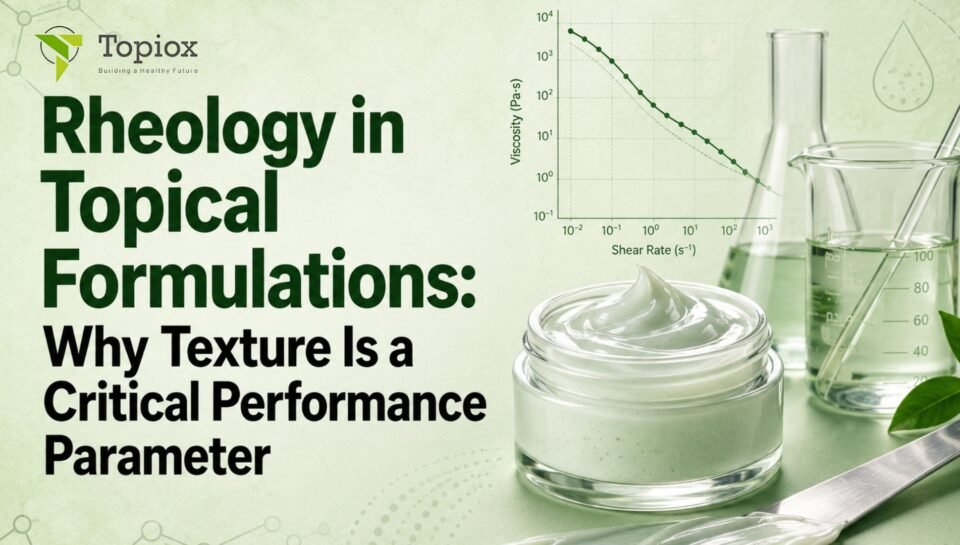
Many topical semisolid formulations exhibit shear-thinning behavior. In a shear-thinning system, apparent viscosity decreases as the applied shear rate increases. This behavior can be particularly useful for topical application. Before application, the product can retain sufficient structure to remain stable within its package. During dispensing and spreading, the increased shear can reduce apparent viscosity, making the product easier to distribute. After application, the formulation may partially or substantially recover its structure depending on its rheological characteristics. From a practical perspective, an appropriately designed shear-thinning profile can contribute to:- easier dispensing,
- smoother spreading,
- reduced application force,
- better control during administration,
- and suitable residence at the application site.
Yield Stress and Topical Product Performance
Yield stress represents the stress required before a structured material begins to flow substantially. This parameter can be particularly relevant for creams, gels, suspensions, and structured semisolid formulations. Appropriate yield behavior may help the product maintain its structure during storage while still allowing it to flow when squeezed from a container or spread across the skin. Yield stress can therefore relate to:- dispensing behavior,
- spreadability,
- suspension stability,
- emulsion structure,
- application force,
- and physical stability.
Thixotropy and Structural Recovery
Thixotropy describes time-dependent structural breakdown under shear followed by recovery after the applied force is reduced or removed. For topical formulations, this can be highly relevant. During application, shear generated by squeezing and spreading can temporarily disrupt the internal structure. After application, structural recovery may help the formulation remain at the treatment site. Thixotropic behavior can therefore provide useful information about:- structural breakdown,
- recovery behavior,
- spreadability,
- physical organization,
- and formulation robustness.
Viscoelasticity: Looking Beyond Flow
Topical semisolids can exhibit both solid-like and liquid-like behavior. This combination is described as viscoelasticity. Oscillatory rheological measurements are commonly used to investigate this behavior without necessarily causing the same degree of structural disruption associated with continuous flow testing. Two important parameters are:Storage Modulus (G′)
The storage modulus represents the elastic or energy-storing component of the material response.Loss Modulus (G″)
The loss modulus represents the viscous or energy-dissipating component. The relationship between G′ and G″ can provide information about the internal structure and relative solid-like or liquid-like character of the formulation. These measurements can help scientists evaluate:- structural strength,
- microstructural organization,
- formulation changes,
- stability-related changes,
- and differences between test and reference products.
What Is a Rheological Fingerprint?
A single viscosity value cannot fully describe a structurally complex topical formulation. A more informative approach is to build a rheological fingerprint using multiple complementary measurements. Depending on the formulation and development objective, this may include:- viscosity across a range of shear rates,
- flow curves,
- yield stress,
- shear-thinning behavior,
- thixotropy,
- storage modulus (G′),
- loss modulus (G″),
- linear viscoelastic region,
- oscillatory yield behavior,
- and structural recovery.
Rheology and Spreadability: Connecting Laboratory Data With Application
One of the most important practical consequences of rheology is spreadability. A topical product must generally be distributed across a defined area of skin without requiring excessive force. Research identifies spreadability as an important performance attribute because it can influence product acceptability, dose uniformity, and patient compliance. Spreadability is influenced by factors including:- viscosity,
- yield stress,
- shear-thinning behavior,
- formulation composition,
- internal structure,
- and interactions between the formulation and application surface.
How Rheology Can Influence Drug Release
Before an API can become available for delivery into or across the skin, it must first be released from its formulation environment. The microstructure and rheological properties of that environment can influence drug mobility. Factors that may affect release include:- viscosity,
- internal phase organization,
- polymer network structure,
- API physical state,
- excipient interactions,
- droplet or particle characteristics,
- and thermodynamic activity of the drug.
Rheology and IVRT: Complementary Tools for Understanding Formulation Performance
In Vitro Release Testing (IVRT) evaluates the release of an API from a topical formulation under defined experimental conditions. Rheology and IVRT answer different but complementary questions. Rheology helps characterize the formulation’s structural and flow behavior. IVRT provides information about drug release performance. When an unexpected IVRT difference appears between formulations, rheological and other Q3 data may help investigate whether differences in the product’s physical structure contributed to the observation. For example, changes in:- viscosity,
- yield stress,
- viscoelasticity,
- internal phase organization,
- or manufacturing-induced structure
Rheology as Part of Q3 Characterization and Topical Bioequivalence
For topical generic drug development, matching API strength alone may not be sufficient to establish that two semisolid products are sufficiently comparable. The internal microstructure of a topical formulation can influence how the product behaves. This is why Q3 characterization is important in the development of many topical semisolid products. Rheological characteristics commonly considered within broader Q3 evaluation can include:- viscosity,
- yield stress,
- flow behavior,
- thixotropy,
- viscoelastic properties,
- and other structure-sensitive rheological parameters.
Why Rheology Matters for Patient Experience
A topical formulation can meet laboratory specifications yet still be difficult or unpleasant to use. Application characteristics can influence whether patients use the product as intended. Rheology affects characteristics such as:- application force,
- ease of dispensing,
- spreadability,
- product retention,
- perceived thickness,
- and structural recovery after spreading.
Rheology Can Reveal Manufacturing and Packaging Effects
Rheological properties are sensitive not only to formulation composition but also to processing history. Changes in:- mixing conditions,
- homogenization,
- cooling rate,
- shear exposure,
- filling operations,
- and dispensing mechanisms
Key Rheological Tests Used in Topical Formulation Development
A comprehensive rheological characterization strategy may use several complementary tests.Flow Curve Analysis
Measures apparent viscosity and flow behavior across a range of shear conditions.Yield Stress Measurement
Evaluates the stress required to initiate substantial flow.Oscillatory Rheology
Characterizes viscoelastic behavior using parameters such as G′ and G″.Thixotropy Testing
Evaluates time-dependent structural breakdown and recovery.Amplitude Sweep Testing
Can help define the linear viscoelastic region and identify structural transitions.Creep and Recovery Testing
Provides information about deformation and recovery under controlled stress. The appropriate combination depends on the dosage form, formulation structure, and purpose of the study.Why Rheological Method Control Matters
Rheological results can be highly sensitive to experimental conditions. Important variables may include:- measurement geometry,
- temperature,
- sample loading,
- sample history,
- equilibration time,
- shear protocol,
- gap settings,
- and test sequence.
Common Rheology Challenges in Topical Formulations
Several formulation problems may become visible through rheological characterization.Excessive Resistance to Flow
The product may become difficult to dispense or spread.Insufficient Structure
The formulation may show undesirable flow, sedimentation, creaming, or other physical instability.Poor Structural Recovery
The product may not rebuild its structure adequately after application or processing.Batch-to-Batch Variability
Differences in manufacturing history or microstructure may produce inconsistent rheological profiles.Test-to-Reference Differences
In generic topical development, rheological differences may indicate broader microstructural differences that require investigation. The objective is not to optimize a single rheological number in isolation, but to understand the complete relationship between structure, process, and performance.Best Practices for Rheological Characterization of Topical Products
Standardize Experimental Conditions
Temperature, geometry, loading procedure, equilibration, and measurement protocols should be carefully controlled.Build a Rheological Fingerprint
Avoid relying only on a single viscosity value. Use complementary measurements where scientifically appropriate.Connect Rheology With Q3 Characterization
Interpret rheological results alongside particle or globule size, microscopy, API physical state, pH, and other relevant structural characteristics.Interpret Rheology Alongside IVRT and IVPT
Where relevant, evaluate whether structural differences correspond with release or permeation differences.Consider Manufacturing History
Understand how shear, mixing, homogenization, cooling, filling, and dispensing may affect product structure.Evaluate Reproducibility
Comparative characterization should consider batch-to-batch variability and analytical method robustness. At topiox research, rheological characterization can be integrated with broader topical formulation and performance studies to help build a more complete understanding of semisolid product behavior.Conclusion
Rheology is far more than a measure of topical product texture. It provides a scientific connection between formulation composition, microstructure, manufacturing history, application behavior, drug release, physical stability, and patient experience. Parameters such as viscosity, yield stress, shear-thinning behavior, thixotropy, G′, and G″ can collectively create a rheological fingerprint that helps scientists understand how a semisolid formulation behaves under different conditions. Rheological characterization is therefore an important component of topical product development and Q3 assessment and, when interpreted alongside composition, microstructure, IVRT, IVPT, and other relevant evidence, can contribute to a scientifically robust topical bioequivalence strategy. At topiox research, rheological characterization can form part of an integrated scientific approach to understanding topical formulation structure, performance, and comparability.FAQ'S
Rheology is the study of how topical formulations flow and deform under applied stress or strain. It is used to characterize properties such as viscosity, yield stress, shear-thinning behavior, thixotropy, and viscoelasticity.
Rheology helps explain how creams and gels behave during manufacturing, storage, dispensing, spreading, and application. It can also provide information about formulation microstructure and physical stability.
Viscosity can influence drug mobility within a formulation, but viscosity alone does not determine release. API properties, thermodynamic activity, formulation microstructure, phase organization, and excipient interactions also influence drug release.
Rheological properties such as viscosity and yield stress influence the force required to spread a topical formulation. Spreadability is relevant to application behavior, dose distribution, product acceptability, and patient experience.
Yes. Rheological properties can form an important part of the physicochemical and microstructural characterization of topical semisolid products.
No. Rheology alone does not establish bioequivalence. It can contribute to a broader characterization and evidence strategy that may include Q1/Q2/Q3 comparison, IVRT, IVPT, and other product-specific evidence.
Common approaches include flow curves, viscosity profiling, yield stress testing, oscillatory rheology, amplitude sweeps, thixotropy testing, and creep-recovery analysis.