What Receptor Medium Should Be Used in IVRT and IVPT Studies?
The receptor medium should maintain adequate sink conditions, provide sufficient drug solubility, remain chemically stable throughout the study, and avoid interactions with the membrane or analytical method. Selection depends on the physicochemical properties of the drug, formulation characteristics, study objectives, and the intended application of the IVRT or IVPT method.Quick Takeaway
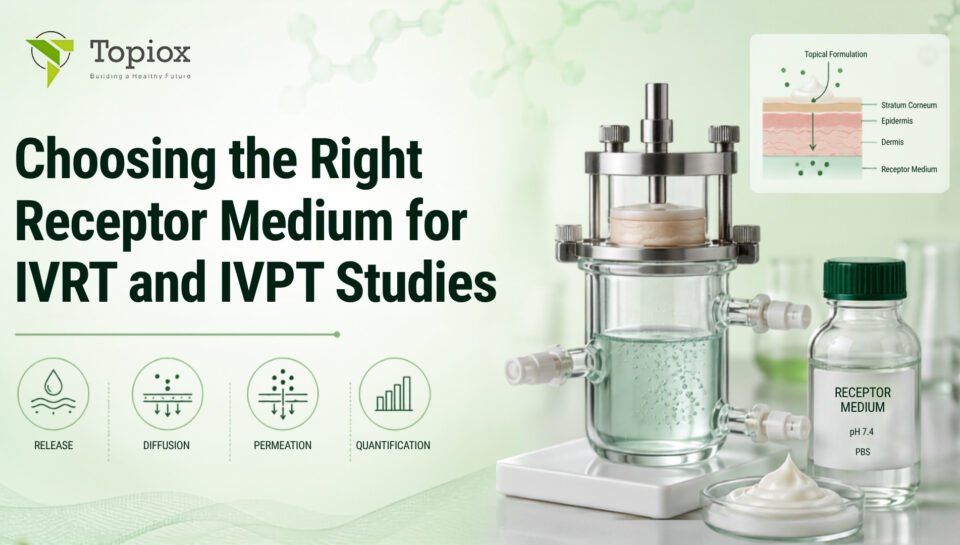
A receptor medium is more than a solvent used during IVRT or IVPT studies. Its composition influences drug release, permeation, analytical recovery, and study reproducibility. Selecting an appropriate receptor medium helps ensure scientifically reliable data and meaningful comparisons between topical formulations.What Is the Role of the Receptor Medium?
The receptor medium serves several important functions during IVRT and IVPT studies. It:- Maintains sink conditions.
- Solubilizes the permeated drug.
- Supports consistent drug diffusion.
- Preserves chemical stability of the API.
- Enables accurate analytical quantification.
Why Sink Conditions Matter
One of the primary objectives of receptor medium selection is maintaining sink conditions. Sink conditions exist when the receptor medium has sufficient capacity to dissolve the permeated drug without approaching saturation. Maintaining sink conditions helps:- Preserve the concentration gradient.
- Support continuous drug diffusion.
- Minimize artificial limitations on permeation.
- Improve study reproducibility.
- Generate meaningful comparative data.
Factors That Influence Receptor Medium Selection
Drug Solubility
The receptor medium should provide adequate solubility for the API throughout the study. Poor solubility may result in drug precipitation or reduced permeation.Drug Stability
The API should remain chemically stable within the receptor medium for the duration of the experiment. Chemical degradation may reduce analytical recovery and affect study accuracy.Membrane Compatibility
The receptor medium should not damage or significantly alter the characteristics of the membrane. Changes in membrane integrity may influence permeation behaviour.Formulation Characteristics
Certain excipients or penetration enhancers may influence receptor medium selection. The medium should support the intended study without introducing formulation-related artifacts.Analytical Compatibility
The receptor medium must be compatible with the analytical method used for quantification, such as HPLC or LC-MS/MS. Interference from buffers or additives should be avoided whenever possible.Commonly Used Receptor Media
Depending on the drug and study objective, receptor media may include:- Phosphate buffer solutions
- Saline-based buffers
- Buffered aqueous systems
- Buffer systems containing surfactants
- Cosolvent-containing receptor media (when scientifically justified)
IVRT vs IVPT: Does Receptor Medium Selection Differ?
Although IVRT and IVPT share many methodological principles, receptor medium selection may differ depending on study objectives.IVRT
The receptor medium is selected to accurately measure drug release from the formulation while maintaining sink conditions and ensuring analytical reliability.IVPT
In addition to maintaining sink conditions, the receptor medium must support physiologically relevant drug permeation through biological membranes without altering membrane integrity. Consequently, receptor medium selection should always be aligned with the purpose of the study rather than using a single medium for every formulation.Common Mistakes in Receptor Medium Selection
Several issues may compromise IVRT and IVPT studies:Assuming One Medium Fits Every Formulation
Different APIs require different receptor media.Ignoring Drug Stability
A medium with adequate solubility but poor chemical stability may generate misleading results.Failing to Verify Sink Conditions
Drug solubility should be confirmed before study initiation.Overlooking Analytical Compatibility
Medium composition should not interfere with quantitative analysis.Topiox Framework for Receptor Medium Selection
At Topiox Research Centre, receptor medium selection can be approached through four scientific considerations:1. API Physicochemical Properties
Assess aqueous solubility, pKa, lipophilicity, and chemical stability.2. Formulation Characteristics
Evaluate excipients, release mechanisms, and dosage form behaviour.3. Study Objectives
Determine whether the study is intended for IVRT, IVPT, formulation screening, or comparative assessment.4. Analytical and Regulatory Considerations
Confirm analytical compatibility, recovery, sink conditions, and method robustness. Using these four considerations together helps develop receptor media that support reliable and reproducible study outcomes.Practical Example
Consider two IVPT studies evaluating the same topical formulation. In the first study, the receptor medium provides limited drug solubility, resulting in partial saturation and reduced permeation rates. In the second study, a scientifically justified receptor medium maintains sink conditions throughout the experiment, allowing continuous diffusion and consistent analytical recovery. Although the formulation is identical, the observed permeation profiles differ because of receptor medium selection rather than product performance. This example highlights why receptor medium optimization is a fundamental aspect of IVRT and IVPT method development.How Topiox Research Centre Supports IVRT and IVPT Method Development
At Topiox Research Centre, IVRT and IVPT method development is designed to generate scientifically reliable, reproducible, and regulatory-aligned data. Our capabilities include:- Receptor medium optimization
- Sink condition assessment
- IVRT method development
- IVPT study design
- Franz diffusion cell studies
- Method validation
- Comparative formulation studies
- Regulatory-focused reporting
Faq's
The receptor medium maintains sink conditions, dissolves the released or permeated drug, supports analytical quantification, and helps ensure reliable study results.
Sink conditions maintain the concentration gradient required for continuous drug release or permeation and help prevent artificial limitations caused by receptor medium saturation.
No. Receptor medium selection should be based on the API’s physicochemical properties, formulation characteristics, and study objectives.
Yes. Inappropriate receptor media may influence drug solubility, permeation, analytical recovery, and overall study reproducibility.
Selection is based on drug solubility, chemical stability, membrane compatibility, sink conditions, analytical compatibility, and the objectives of the IVRT or IVPT study.