
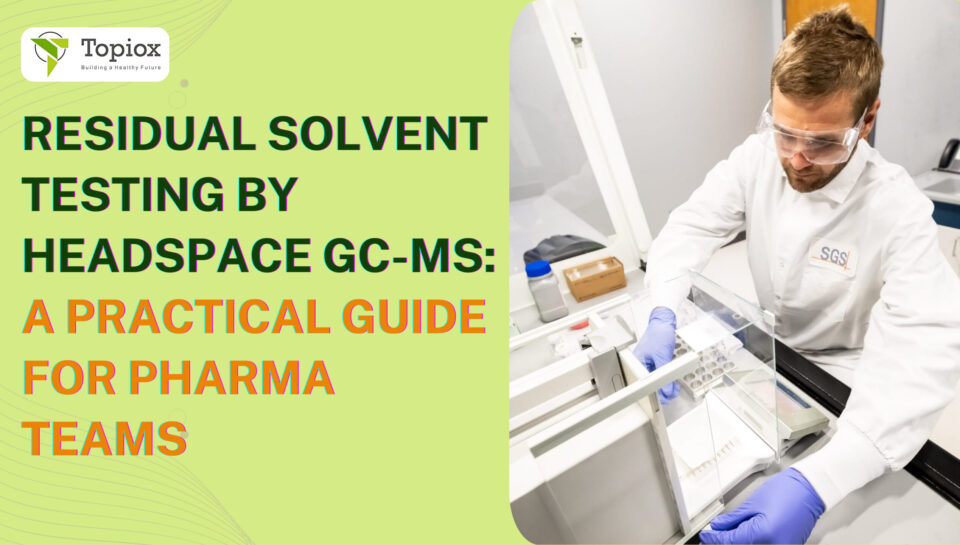
Residual solvents may be present in very small amounts, but their impact on pharmaceutical quality can be significant.
They can affect product safety, impurity profiles, stability, regulatory acceptability, and batch release decisions.
That is why residual solvent testing by Headspace GC-MS remains a critical part of pharmaceutical analysis.
For pharma teams involved in development, quality control, validation, and regulatory submission, this testing is not just a routine requirement.
It is an essential way to confirm that volatile organic impurities are properly understood, controlled, and kept within acceptable safety-based limits.
From early-stage development to commercial manufacturing, a reliable residual solvent testing strategy helps reduce compliance risks, strengthen process understanding, and support better product quality decisions.
Direct Answer: What Is Residual Solvent Testing by Headspace GC-MS?
Residual solvent testing by Headspace GC-MS is a pharmaceutical analytical technique used to detect and quantify volatile organic solvents remaining in APIs, intermediates, excipients, and finished drug products.
It works by heating a sealed sample vial so volatile compounds move into the gas phase, which is then analysed using gas chromatography and mass spectrometry.
This approach helps pharmaceutical teams monitor solvent residues accurately, improve impurity control, and support quality, safety, and regulatory compliance.
Why Residual Solvents Matter in Pharmaceutical Products
Residual solvents are volatile chemicals that remain in materials after manufacturing processes.
They may be introduced during:
- synthesis,
- purification,
- cleaning,
- granulation,
- coating,
- or excipient manufacturing.
Although these solvents may play an important role during processing, they do not contribute therapeutic value to the final product.
Instead, if they remain above acceptable levels, they can create serious quality and compliance concerns.
Residual solvents may affect:
- product safety,
- impurity levels,
- physical stability,
- odour,
- and overall product acceptability.
If they are not properly controlled, they may lead to out-of-specification results, batch rejection, additional investigations, reformulation work, or regulatory observations.
That is why pharmaceutical teams need sensitive, selective, and well-validated analytical methods to monitor them effectively.
What Is Headspace GC-MS Analysis in Pharmaceutical Testing?
Headspace GC-MS analysis is an analytical technique used to identify and quantify volatile compounds in complex samples.
In this method, the sample is placed inside a sealed vial and heated under controlled conditions.
As the temperature rises, volatile compounds move into the gas phase above the sample.
This vapour phase, called the headspace, is then introduced into the gas chromatograph.
The gas chromatograph separates the volatile compounds, while the mass spectrometer detects and identifies them based on their mass-to-charge pattern.
Because the system analyses the vapour phase rather than injecting the full sample matrix directly, it is especially useful for pharmaceutical materials that may be difficult to analyse using direct injection methods.
This makes Headspace GC-MS a highly effective technique for residual solvent testing in regulated pharmaceutical environments.
Why Headspace GC-MS Is Preferred for Residual Solvent Testing
Residual solvents are volatile by nature.
That makes headspace sampling a practical and scientifically appropriate approach for their analysis.
Instead of introducing the full sample matrix into the analytical system, Headspace GC-MS focuses on the volatile components most relevant to solvent residue assessment.
This offers several important advantages.
Lower Matrix Interference
Since only volatile compounds in the headspace are analysed, non-volatile sample components are less likely to interfere with the system.
This improves data quality and reduces analytical complexity.
Cleaner Chromatographic Performance
Headspace sampling helps produce cleaner chromatograms, which makes peak interpretation easier and more reliable.
Better Suitability for Complex Pharmaceutical Samples
Many APIs, excipients, and finished products contain matrices that are not ideal for direct injection.
Headspace sampling improves compatibility with such materials.
Improved Sensitivity for Volatile Compounds
The technique is well suited for the detection and quantification of volatile analytes present at low levels.
Reduced Sample Preparation Burden
Compared with more complex extraction-based methods, Headspace GC-MS can offer a more efficient and controlled sample preparation workflow.
These advantages make it a widely preferred technique for routine solvent control, impurity evaluation, and regulatory testing support.
Where Residual Solvent Testing Is Used Across the Pharma Lifecycle
Residual solvent testing is relevant at multiple stages of pharmaceutical development and manufacturing.
It may be applied during:
- API development,
- excipient qualification,
- formulation development,
- process optimisation,
- process validation,
- release testing,
- stability studies,
- and regulatory submission support.
Common sample types include:
- active pharmaceutical ingredients,
- intermediates,
- excipients,
- granules,
- coated tablets,
- capsules,
- semisolid formulations,
- and finished dosage forms.
This broad applicability is one reason why Headspace GC-MS remains such a valuable analytical tool for pharmaceutical organisations.
Key Method Development Considerations for Headspace GC-MS
Residual solvent analysis cannot rely on a generic method for every product.
Sample behaviour can vary significantly depending on the matrix, solvent profile, thermal sensitivity, and product composition.
That is why method development is one of the most important stages in building a reliable Headspace GC-MS workflow.
Sample Diluent Selection
The diluent must adequately dissolve or disperse the sample without interfering with solvent recovery or chromatographic performance.
A poor diluent choice can affect sensitivity, cause distorted peak shapes, or create carryover issues.
Incubation Temperature
The incubation temperature must be high enough to transfer volatile analytes into the headspace efficiently.
At the same time, it must not cause thermal degradation of the sample.
This is especially important for temperature-sensitive APIs and excipients.
Incubation Time
The sample must be allowed to equilibrate long enough to ensure consistent volatile transfer into the headspace.
Insufficient time may reduce reproducibility.
Excessive time may increase background signals or alter sample behaviour.
Injection and Split Conditions
Injection parameters influence peak intensity, detector response, and overall analytical performance.
Careful optimisation is essential for consistent quantification.
Column Selection
The analytical column must provide appropriate separation for the full target solvent panel.
This becomes especially important when multiple solvents are present in the same run or where co-elution risk is high.
A robust method depends on careful optimisation of all of these variables.
Why Method Validation Is Essential
Even a well-designed method has limited value unless the data it generates can be trusted.
That is why method validation is essential in pharmaceutical residual solvent testing.
For Headspace GC-MS methods, validation commonly includes:
- specificity,
- linearity,
- accuracy,
- precision,
- detection limit,
- quantification limit,
- robustness,
- and system suitability.
Without proper validation, even technically correct-looking results may not be acceptable during audits, regulatory review, or product release decisions.
Validation becomes especially important when the method supports:
- release testing,
- stability programs,
- impurity investigations,
- process validation,
- or regulatory submissions.
A validated Headspace GC-MS method provides confidence that solvent levels are being measured accurately and reproducibly within the intended use of the method.
Common Challenges in Residual Solvent Testing
Residual solvent analysis may appear simple in concept, but in practice, it can involve several technical challenges.
Matrix Effects
Different materials release volatile compounds differently into the headspace.
A method that works well for one matrix may perform poorly for another.
Thermal Degradation
Some samples may degrade during incubation and generate new volatile compounds.
This can create misleading peaks and complicate interpretation.
Co-Elution
If chromatographic separation is not sufficient, solvent peaks may overlap.
This affects reliable identification and quantification.
Low-Level Detection Requirements
Some solvents must be monitored near very low specification levels.
This requires careful optimisation of method sensitivity and system performance.
Reproducibility Problems
Inconsistent vial sealing, uncontrolled equilibration, and poor sample preparation can reduce reproducibility and compromise data quality.
These challenges can be managed successfully, but they must be addressed early through proper method development, validation, and analytical control.
How Residual Solvent Data Supports Regulatory Compliance
Residual solvent testing is closely linked to pharmaceutical compliance expectations.
Regulatory authorities expect manufacturers to demonstrate that volatile impurities are controlled using suitable methods and justified limits.
That means residual solvent data should be:
- accurate,
- traceable,
- method validated,
- scientifically defensible,
- and aligned with a broader quality control strategy.
Weak solvent data can lead to:
- reviewer questions,
- method-related deficiencies,
- additional clarification requests,
- delayed approvals,
- failed batches,
- or repeated investigations.
A strong Headspace GC-MS program helps reduce these risks by making solvent control part of a proactive and well-structured quality framework.
The Strategic Role of Residual Solvent Testing in Development
Residual solvent testing should not be treated only as a release-stage activity.
It also adds value much earlier in the development cycle.
During development, it can help teams:
- compare synthetic routes,
- evaluate purification efficiency,
- assess drying performance,
- qualify excipients,
- support formulation decisions,
- investigate impurity trends,
- and optimise manufacturing processes.
In this way, Headspace GC-MS supports not only regulatory compliance, but also better scientific decision-making.
When solvent behaviour is understood early, downstream quality issues can often be reduced.
Best Practices for Reliable Headspace GC-MS Testing
Reliable residual solvent testing depends on disciplined analytical planning and execution.
The following best practices improve data quality and reduce risk.
Use Matrix-Appropriate Method Development
Do not assume one method will work equally well for every sample type.
Method conditions should reflect the behaviour of the actual pharmaceutical matrix.
Validate According to Intended Use
A screening method is different from a release method.
Validation should match the role the method plays in the quality system.
Control Incubation and Injection Conditions Carefully
Small changes in temperature, timing, and injection settings can affect volatile recovery and reproducibility.
Assess Sample Thermal Stability
Make sure the method is measuring the true solvent profile and not volatile artifacts created by analytical conditions.
Maintain Clear Documentation
Residual solvent methods are often reviewed during audits and submissions.
Well-documented development and validation work improves data defensibility.
How Topiox Research Supports Residual Solvent Testing
At Topiox Research, residual solvent testing is approached as more than a routine analytical requirement.
It is treated as an important part of pharmaceutical quality, compliance, and development strategy.
Topiox Research supports pharma teams through:
- Headspace GC-MS method development for complex pharmaceutical matrices,
- method validation for QC, stability, and regulatory applications,
- support for volatile impurity investigations,
- analytical assessment of APIs, intermediates, excipients, and finished dosage forms,
- and scientifically structured testing aligned with quality and compliance expectations.
This approach helps pharmaceutical companies generate solvent data that is reliable, defensible, and useful across both development and commercial workflows.
Conclusion
Residual solvents may be present at low levels, but their effect on pharmaceutical quality and compliance can be substantial.
That is why residual solvent testing by Headspace GC-MS remains a core part of modern pharmaceutical analysis.
It helps pharma teams detect volatile impurities accurately, strengthen quality control strategies, support compliance expectations, and make more informed development decisions.
When the method is properly developed, validated, and applied to the right matrix, it becomes far more than a routine laboratory test.
It becomes a reliable scientific tool for protecting product quality, patient safety, and regulatory confidence.
For pharmaceutical companies seeking dependable analytical support, Topiox Research provides a structured and scientific approach to Headspace GC-MS testing that supports both development goals and compliance requirements.
Need reliable residual solvent testing support for your pharmaceutical product? Connect with Topiox Research for scientifically structured Headspace GC-MS analysis, method development, and validation support.
Faq's
Residual solvent testing is the analysis of volatile organic solvents that remain in APIs, excipients, intermediates, or finished drug products after manufacturing.
It helps ensure solvent levels remain within acceptable limits for safety, quality, and regulatory compliance.
Headspace GC-MS is widely used because it is highly suitable for volatile compounds.
It analyses the vapour phase above the sample, which reduces matrix interference and improves solvent detection in complex pharmaceutical materials.
The technique can be used for APIs, intermediates, excipients, and finished dosage forms.
Its suitability depends on proper method development and validation for the specific sample matrix.
Method validation confirms that the analytical procedure is accurate, precise, specific, and reliable for its intended purpose.
Without validation, results may not be acceptable for release, stability, investigation, or submission use.
Common issues include matrix effects, thermal degradation, poor solvent recovery, co-eluting peaks, and weak reproducibility.
These problems are usually addressed through proper method development, system optimisation, and controlled analytical conditions.