
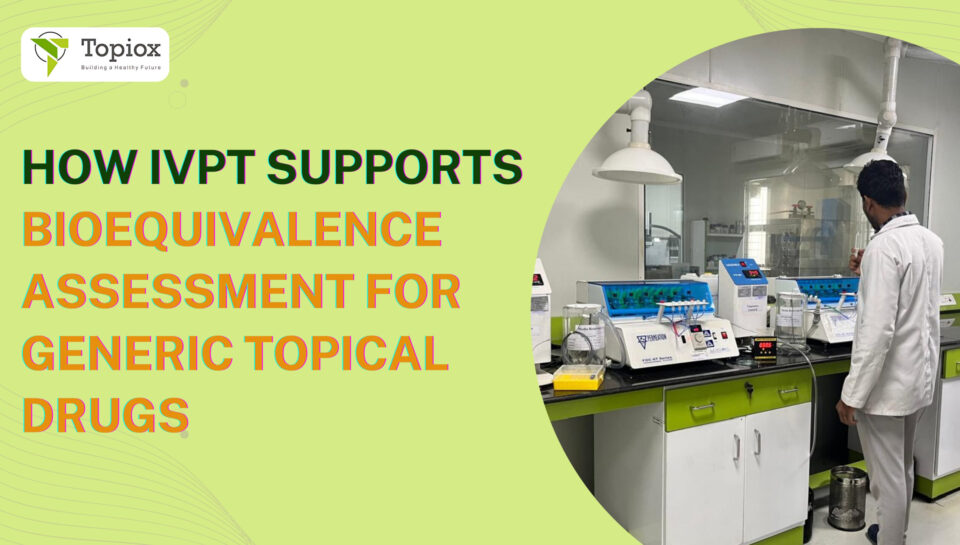
The development of generic topical drugs requires more than just chemical equivalence, it demands therapeutic equivalence. Establishing bioequivalence (BE) between a generic and its reference product is a critical step for regulatory approval.
For topical and transdermal formulations, where systemic absorption is minimal, In Vitro Permeation Testing (IVPT) has become one of the most powerful tools for assessing bioequivalence.
IVPT testing measures the rate and extent of drug permeation through human or synthetic skin, providing reliable scientific data that supports both formulation optimization and regulatory submission.
At Topiox Research, our scientists conduct IVPT studies using validated methodologies aligned with FDA and EMA guidance to support generic drug development and ensure successful bioequivalence demonstration.
What is IVPT and Why It Matters
In Vitro Permeation Testing (IVPT) is an experimental technique that simulates how a drug penetrates through the skin or a membrane barrier. It is designed to mimic real-world application conditions for topical formulations such as creams, gels, ointments, and lotions.
During an IVPT study, the drug formulation is applied onto a skin membrane mounted on a diffusion cell (commonly Franz diffusion cells). The receptor compartment is filled with a physiological medium, and the amount of drug permeating through the membrane is measured over time.
This process provides a drug permeation profile, which is used to compare the test (generic) and reference (innovator) products for bioequivalence.
The Regulatory Framework for IVPT-Based Bioequivalence
Regulatory authorities worldwide have recognized IVPT testing as a scientifically sound approach to evaluate bioequivalence for topical and transdermal products.
Key Regulatory Guidelines:
- U.S. FDA Guidance – “Topical Dermatological Drug Product Development: In Vitro Release Test Studies and Associated Analytical Methods” (2016)
- FDA Product-Specific Guidances (PSGs) – Define specific IVPT requirements for individual topical APIs.
- EMA Reflection Paper (2018) – Endorses IVPT and IVRT as reliable surrogates for clinical BE studies.
- ICH Q8(R2) – Emphasizes Quality by Design (QbD) approaches in analytical method validation and performance testing.
These agencies accept IVPT data as evidence of bioequivalence when the test and reference products exhibit statistically similar permeation profiles across the skin membrane.
How IVPT Supports Bioequivalence Assessment
1. Quantifies Drug Permeation Through Skin
The main purpose of IVPT testing is to quantify how much and how fast the drug penetrates the skin layers. By analyzing steady-state flux, lag time, and cumulative permeation, scientists can compare drug delivery efficiency between the generic and reference product.
If both exhibit comparable permeation behavior, it provides strong scientific evidence that they are bioequivalent.
2. Eliminates the Need for Costly In Vivo Studies
Conducting in vivo bioequivalence trials for topical drugs is often expensive, time-consuming, and ethically complex. IVPT testing serves as a reliable in vitro alternative, offering high precision, reproducibility, and regulatory acceptance for topical drug submissions.
For many products, FDA and EMA now allow IVPT data to replace in vivo studies, significantly reducing development costs and time-to-market for generic formulations.
3. Demonstrates Formulation Sameness
IVPT testing helps confirm that the formulation of the generic drug behaves identically to that of the reference product in terms of drug release and permeation kinetics.
When combined with Q1/Q2/Q3 characterization, IVPT data reinforces formulation sameness across qualitative composition, quantitative proportions, and microstructural behavio, all essential for regulatory bioequivalence approval.
4. Supports Quality by Design (QbD) Development
IVPT studies provide valuable data on how formulation variables affect drug permeation performance. This allows formulation scientists to use QbD principles to optimize formulation parameters, such as viscosity, excipient concentration, and solubilizers, to achieve desired drug delivery performance.
5. Ensures Global Regulatory Acceptance
Data generated from validated IVPT studies are accepted by regulatory agencies worldwide. FDA, EMA, Health Canada, and CDSCO recognize IVPT testing as a scientifically valid approach to demonstrate bioequivalence for topical generic drugs.
By following standardized protocols, Topiox Research ensures that all IVPT studies are compliant, reproducible, and globally acceptable for submission.
IVPT Testing at Topiox Research

At Topiox Research, we conduct IVPT studies under controlled laboratory conditions using validated diffusion systems and regulatory-compliant protocols. Our services cover the full spectrum of bioequivalence testing for topical products, from study design to data interpretation.
Our IVPT Services Include:
- Custom protocol design based on FDA and EMA guidance
- Use of Franz diffusion cells with validated human or synthetic membranes
- Sampling and analysis using HPLC, LC-MS, or UV-Vis spectrophotometry
- Calculation of permeation parameters: flux, lag time, cumulative amount, and permeation coefficient
- Statistical comparison of test vs. reference permeation profiles
- Preparation of regulatory submission reports and bioequivalence summaries
Why Choose Topiox Research for IVPT Studies
- Regulatory Expertise: Our IVPT protocols comply with FDA, EMA, and ICH guidelines for topical bioequivalence testing.
- Scientific Excellence: Our experienced scientists ensure every study is scientifically rigorous and methodologically sound.
- Advanced Analytical Infrastructure: Equipped with Franz diffusion systems, precision temperature controls, and validated analytical instruments.
- Comprehensive Data Packages: Complete, audit-ready reports designed for ANDA, NDA, and global dossier submissions.
Global Reach: Serving pharmaceutical partners across India and international markets from our facility in Navi Mumbai.
Conclusion
IVPT testing is no longer just a regulatory formality; it’s a scientific necessity for ensuring that generic topical formulations perform equivalently to their reference counterparts.
By providing precise, reproducible data on drug permeation and release, IVPT testing strengthens the bioequivalence claim and streamlines regulatory submissions. At Topiox Research, we combine scientific rigor, regulatory insight, and state-of-the-art analytical capability to deliver reliable IVPT data that accelerate your generic topical drug development with confidence and compliance.