Developing a topical drug product isn’t just a formulation exercise, it’s a precision-controlled science that must balance skin permeability, stability, and regulatory expectations.
Across India and global pharma hubs, teams often face a common issue: a formulation that looks perfect in the lab fails in stability studies, bioequivalence testing, or regulatory review.
At Topiox Research Centre in Navi Mumbai, we work with pharmaceutical innovators and generic manufacturers to build formulations that don’t just pass testing, they perform consistently and meet global regulatory standards.
This article unpacks the real challenges in topical drug formulation, how these affect stability and efficacy, and how early scientific design can save months of development time.
Why Formulation Development Is the Foundation of Product Success
Formulation development isn’t about blending ingredients, it’s about creating a controlled system that can protect the drug, deliver it effectively, and remain stable over time.
Every choice, from excipient selection to emulsification speed, defines the drug’s behavior, release rate, and shelf-life.
At Topiox, formulation design begins with:
- Understanding API physicochemical properties solubility, particle size, polymorphism
- Matching functional excipients to stabilize the matrix
- Predicting microstructural behavior using rheology and microscopy
- Simulating long-term stability during formulation optimization
This scientific groundwork prevents costly reformulations during validation or regulatory review.
The Skin Barrier: The First Challenge in Topical Delivery
The stratum corneum, skin’s outermost layer, is designed to block substances making it the toughest obstacle for topical products.
Core Formulation Challenges
- APIs with poor lipophilicity or large molecular weight struggle to penetrate.
- Skin pH and lipid composition vary between individuals.
- Enhancers can increase absorption but also irritation risk.
Scientific Solutions
- Use permeation enhancers for balance.
- Optimize emulsion or micellar systems for controlled release.
- Validate through In Vitro Permeation Testing (IVPT) using Franz diffusion cells.
At Topiox, our IVRT and IVPT programs are designed to mimic biological skin behavior, giving accurate predictive data before clinical stages.
The Chemistry Behind Stability Why Formulation Comes First
A formulation’s stability determines how it behaves during transport, storage, and patient use.
Most stability issues phase separation, degradation, loss of potency begin at the formulation design level, not during testing.
Types of Stability to Control
- Physical Stability: Preventing phase separation, creaming, or viscosity drift.
- Chemical Stability: Avoiding oxidation, hydrolysis, or API-excipient interaction.
- Microbiological Stability: Ensuring preservative efficacy throughout shelf life.
How Topiox Ensures Stability
Our development protocol follows ICH Q1A (R2), integrating accelerated stress studies early in the design phase.
We use DSC, FTIR, and HPLC to detect degradation pathways before scale-up ensuring every product is both scientifically sound and regulator-ready.
Excipient Compatibility: The Hidden Determinant of Product Quality
Excipients define how the drug behaves within the formulation. Even small changes can alter product texture, absorption, or shelf life.
Common Failures
- pH drift leading to API precipitation.
- Surfactant instability triggering emulsion breakdown.
- Reactive preservatives degrade the active.
Our Scientific Approach
Topiox performs comprehensive compatibility testing using:
- Differential Scanning Calorimetry (DSC) to detect heat-based interactions.
- Fourier Transform Infrared Spectroscopy (FTIR) to identify chemical bonding.
- HPLC profiling for real-time degradation analysis.
We correlate formulation data with performance outcomes, ensuring the selected excipients support both stability and efficacy.
The Microstructure and Rheology Connection
A topical product’s microstructure is its fingerprint. It defines how it feels, spreads, and releases the drug.
If the internal structure collapses, stability and performance fail.
Key Risks
- Droplet coalescence in emulsions.
- Texture inconsistency across batches.
- Loss of yield stress affecting application uniformity.
Topiox Solution
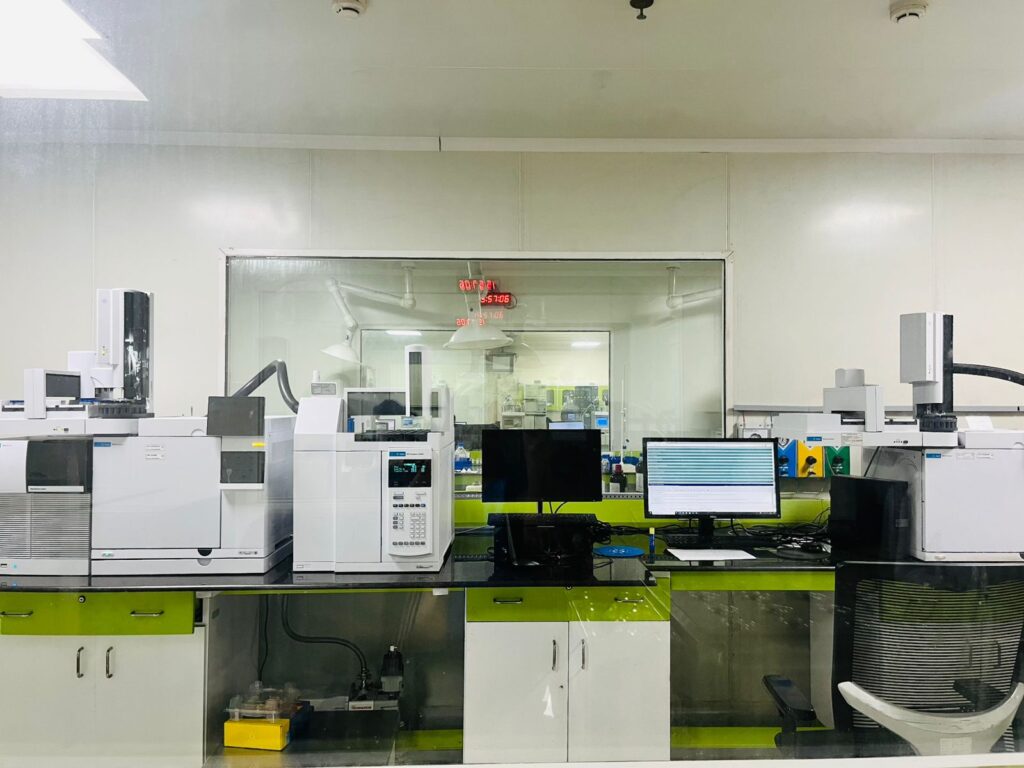
Our labs use rheometers, particle size analyzers, and optical microscopy to monitor:
- Viscosity and thixotropy
- Droplet size distribution
- Phase uniformity
This precision ensures batch-to-batch consistency and sustained product performance.
Formulation and Drug Efficacy – The Invisible Link
A drug’s effectiveness is only as good as its formulation allows it to be.
The right formulation ensures controlled drug release, efficient penetration, and consistent therapeutic outcomes.
How Formulation Drives Efficacy
- Controls release kinetics for steady-state delivery.
- Maintains bioavailability by optimizing solubility.
- Ensures uniform drug distribution in every dose.
Topiox validates these relationships through IVRT and IVPT correlation studies, helping clients demonstrate bioequivalence without full-scale clinical trials.
For a detailed view of how formulation integrates into complete topical product development, explore
Topical Product Development: End-to-End Solutions for Pharma and R&D.
Common Failures – And How to Prevent Them
Scenario 1: Phase Separation During Accelerated Studies
A hydrocortisone cream failed stability testing after 3 months.
Root cause: incompatible emulsifier blend and poor homogenization control.
Fix: process optimization and rheology tuning to maintain phase integrity.
Scenario 2: Loss of Potency in Antifungal Gel
A topical gel lost 15% potency under high humidity.
Root cause: oxidative degradation triggered by excipient selection.
Fix: inclusion of antioxidants and controlled pH buffering, verified through LC-MS.
These examples highlight that formulation flaws, not testing errors, cause most late-stage failures.
Why Early Formulation Work Prevents Regulatory Delays
Early optimization doesn’t just improve stability it reduces regulatory risk.
Once a formulation fails stability or equivalence, repeating studies delays filing by months.
Proactive formulation design helps:
- Avoid repeating IVRT and IVPT.
- Generate reproducible, regulator-ready data.
- Streamline ANDA or global dossier submissions.
At Topiox, we build formulation data packages that align with FDA, EMA, and CDSCO standards from day one.
Manufacturing Scale-Up: Keeping Structure Under Pressure
During scale-up, process dynamics can change everything.
Temperature, shear rate, and mixing time can alter microstructure and viscosity.
Our Strategy
We conduct Design of Experiments (DoE) studies to define Critical Process Parameters (CPPs), ensuring:
- Consistent texture across scales.
- Uniform droplet size and distribution.
- Reproducibility under GMP conditions.
Regulatory Documentation Where Good Science Fails Without Good Data
Many companies lose time not because of bad results, but because of incomplete documentation.
Conclusion
In topical drug development, formulation design determines everything from physical stability and drug release to regulatory confidence.
The right formulation transforms a promising API into a reliable, compliant, and effective drug product.
The wrong one triggers failures, delays, and costly rework. At Topiox Research Centre, we integrate formulation science, analytical precision, and regulatory compliance into every development program ensuring your topical products are stable, effective, and regulator-approved.