Developing a topical or dermal drug product isn’t just about combining ingredients, it’s about achieving precise formulation performance that translates to clinical reliability and regulatory acceptance.
At Topiox Research, we specialize in topical product development services in India, helping global pharmaceutical and cosmetic brands design, optimize, and validate topical dosage forms that meet international standards.
From formulation design and optimization to IVRT and IVPT testing, our development programs ensure your products are scientifically sound, compliant, and ready for market submission. For a detailed overview of the formulation journey, read our Step-by-Step Guide to Topical Formulation Development.
Operating from Navi Mumbai, our lab integrates formulation science, analytical expertise, and regulatory understanding to support both new and generic topical products for global markets.
What Is Topical Product Development in Pharmaceuticals
Topical product development focuses on designing formulations that deliver active pharmaceutical ingredients (APIs) through the skin for local or systemic effects.
Unlike simple compounding, pharmaceutical topical formulation development is a controlled, data-driven process that ensures stability, efficacy, and patient acceptability. It requires balancing physical and chemical interactions among APIs, excipients, and the delivery medium.
Common dosage forms include creams, gels, ointments, lotions, sprays, and patches each requiring unique formulation strategies based on solubility, rheology, and drug release behavior.
At Topiox Research, our scientists understand the complexities of formulation science and regulatory expectations, ensuring every formulation meets FDA, EMA, and CDSCO standards for safety and consistency.
Why Topical Formulation Development Is Scientifically Challenging
Topical and transdermal product development is one of the most demanding areas in pharmaceutical R&D. The skin’s structure, particularly the stratum corneum, acts as a highly selective barrier, allowing only specific molecules to pass through.
To ensure adequate permeation, scientists must optimize several interdependent factors:
- Drug solubility within the base and skin lipids
- Excipients and penetration enhancers that affect drug transport
- Microstructure and rheology, which determine spreadability and release
- pH, viscosity, and emulsification, which influence stability and patient comfort
Even minor changes to excipient grade or process parameters can alter drug release, leading to failure in IVRT or IVPT studies.
At Topiox Research, our formulation scientists take a structured approach integrating analytical validation, Q3 characterization, and stability data to ensure consistent performance across batches. Learn about common formulation hurdles and proven solutions in our blog Challenges in Topical Drug Product Development and How to Solve Them.
End-to-End Topical Product Development Approach
Our end-to-end topical product development program is designed to guide products from concept to clinical readiness under controlled scientific and regulatory frameworks.
- Pre-Formulation Studies
We analyze the API’s physicochemical properties, solubility, pKa, partition coefficient, and thermal behavior to determine ideal excipient combinations. - Formulation Design and Optimization
Using design of experiments (DoE), we balance excipients to achieve the right microstructure, viscosity, and drug-release kinetics. - Stability and Performance Evaluation
We perform accelerated and long-term stability studies under ICH Q1A(R2) conditions to assess phase separation, pH drift, and degradation. - In-Vitro Evaluation (IVRT & IVPT)
Our IVRT ([In-Vitro Release Testing]) and IVPT ([In-Vitro Permeation Testing]) studies confirm that formulations deliver drugs effectively through skin or synthetic membranes. - Regulatory Documentation and Scale-Up
Every stage is documented following GMP, GLP, and ICH Q2(R2) requirements, ensuring readiness for ANDA or 505(b)(2) submissions.
This structured, multidisciplinary approach guarantees that your topical formulations are technically validated and globally compliant.
Role of Formulation Development in Stability and Efficacy
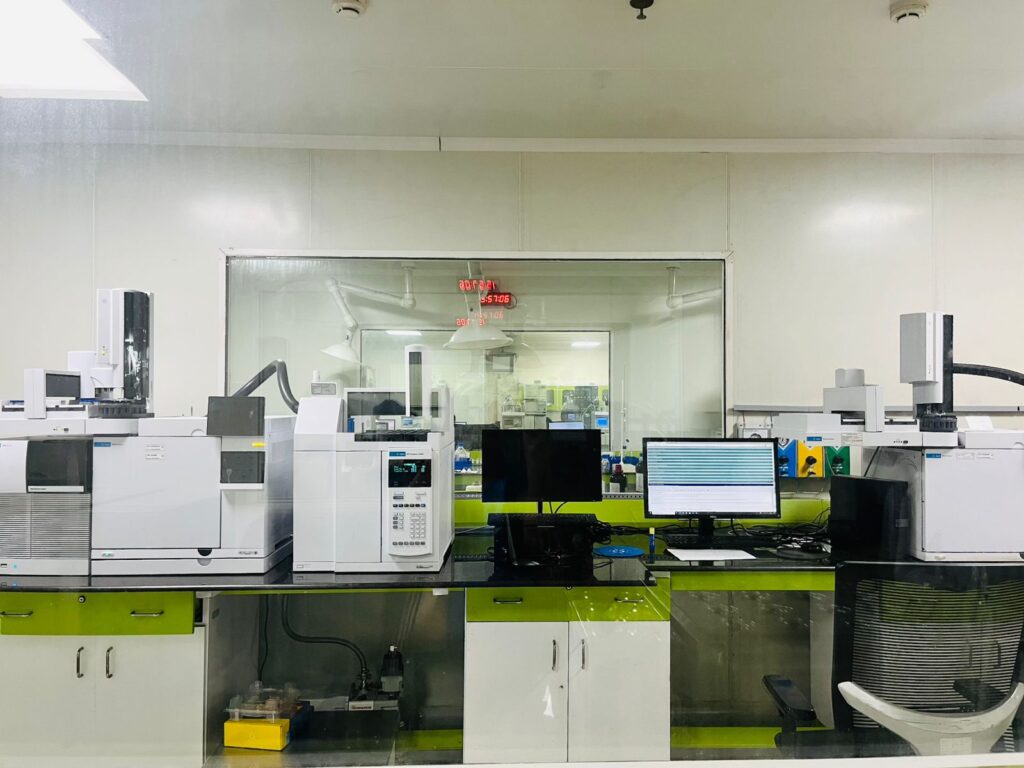
A well-designed topical formulation maintains both physical integrity and therapeutic performance throughout its shelf life.
At Topiox Research, we evaluate how formulation components interact to affect stability, release, and bioavailability. Our stability programs assess physical changes (color, viscosity, phase separation), chemical degradation (API breakdown), and microbiological safety.
We also perform excipient compatibility studies, ensuring inactive ingredients do not compromise potency or safety.
Drug release and permeation are assessed using Franz diffusion cells ([Franz Diffusion Cell Services]), linking formulation structure directly with bioavailability outcomes.
The result is a formulation that not only passes stability testing but also performs consistently in IVRT and IVPT evaluations, ensuring robust data for regulatory filing and commercialization. Discover how formulation design directly impacts product performance in Role of Formulation Development in Product Stability and Efficacy.
Real-World Use Cases
- Generic Formulation Optimization
A global generic manufacturer approached Topiox after repeated IVRT mismatches with their reference product. Through microstructural adjustment and viscosity optimization, our team achieved Q3 equivalence and successful ANDA submission. - Reformulation for Stability Improvement
A topical corticosteroid formulation exhibited phase separation during stability testing. Our expedient re-screening and rheology tuning improved homogeneity and prolonged shelf life under ICH Zone IVb conditions. - Cosmetic-to-Pharma Transition
A dermocosmetic company seeking to reposition a moisturizer as a medicated product used our skin hydration studies ([Skin Hydration Study Services]) and IVRT data to substantiate clinical claims. To understand how skin moisture analysis validates efficacy claims, explore How Skin Hydration Studies Support Topical Product Claims
Each case demonstrates the importance of early scientific intervention preventing costly delays in validation and regulatory review.
Common Mistakes in Topical Product Development
Many formulation projects fail not due to poor API performance, but because of avoidable development errors.
Common mistakes include:
- Skipping excipient compatibility testing, leading to degradation or instability
- Late-stage reformulation after failed IVRT or IVPT data
- Over-reliance on visual observation, ignoring microstructural differences
- Neglecting rheology and viscosity optimization, resulting in inconsistent spreadability
- Ignoring Q3 characterization, which is essential for demonstrating sameness in generics
At Topiox Research, we mitigate these risks through integrated analytical testing ([Analytical Testing Services]) and method development ([Method Development & Validation]), ensuring formulation consistency from the start. Learn why early formulation alignment prevents costly reformulations in Why Early Formulation Optimization Saves Time and Cost.
Why Work with a Specialized Research Laboratory
Partnering with a specialized CRO like Topiox Research provides a distinct advantage for pharmaceutical and dermal R&D programs.
Our lab in Navi Mumbai integrates formulation development, analytical chemistry, and regulatory science under one roof. This eliminates data silos and accelerates decision-making.
Key strengths include:
- Expertise across semi-solid and transdermal formulation systems
Experience, Expertise, Authoritativeness, Trust
- Experience: Over a decade of hands-on experience in topical and transdermal product development.
- Expertise: Skilled formulation chemists, analytical scientists, and QA professionals with deep regulatory understanding.
- Authoritativeness: Compliance with ICH Q2(R2), Q3, and USP <1724> for in-vitro testing.
- Trustworthiness: Transparent data, validated methods, and complete traceability in every report.
“At Topiox Research, every formulation we design undergoes rigorous scientific evaluation because patient safety and regulatory integrity begin at the formulation stage.”
Local and Global Relevance
Located in Navi Mumbai, India, Topiox Research supports clients in India, the United States, Europe, and Asia-Pacific.
Our data packages meet global expectations for ANDA, 505(b)(2), and cosmetic regulatory submissions.
With India emerging as a hub for contract research and development, Topiox bridges the gap between innovation and compliance, delivering high-quality results for global pharmaceutical partners.
Conclusion: Science-Led Development for Topical Formulation Success
Reliable topical drug development requires more than mixing ingredients; it demands scientific discipline, analytical depth, and regulatory insight.
At Topiox Research, we offer end-to-end topical product development services from formulation design, IVRT/IVPT testing, and Q3 characterization to regulatory documentation.
Whether developing a new dermatological product or a generic formulation, our integrated approach ensures every product is performance-driven, compliant, and ready for approval.If you’re looking for a partner who understands both science and regulation, connect with Topiox Research in Navi Mumbai, your trusted collaborator in topical product innovation.